
Acrylic CNC machining is used when parts need optical clarity, precision geometry, and cleaner edges than molded PMMA can provide.
Acrylic (PMMA) occupies a unique position in CNC machining: it delivers optical clarity approaching glass, machines with clean chip formation, and costs a fraction of polycarbonate or PEEK. But it is also brittle, heat-sensitive, and prone to stress cracking if machined with incorrect feeds and speeds. The line between a diamond-polished edge and a shattered corner often comes down to 0.05 mm chip load and 500 RPM.
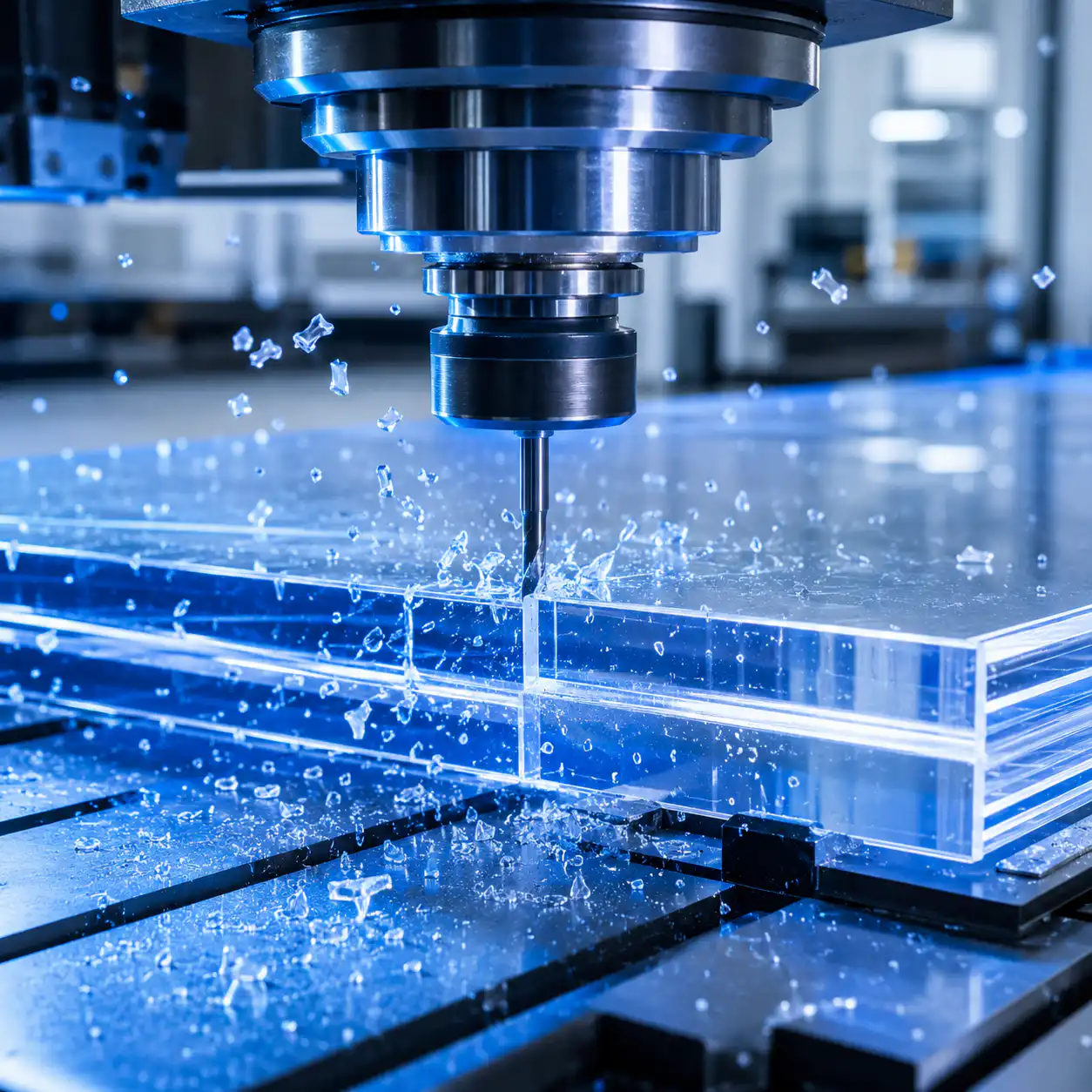
Acrylic CNC machining is used when parts need optical clarity, precision geometry, and cleaner edges than molded PMMA can provide.
This guide covers the specific tooling, feed rates, coolant strategies, and fixturing techniques that produce glass-like surface finishes on acrylic parts without cracking, chipping, or heat damage. Whether you are machining optical lenses, medical manifolds, or retail display components, the parameters below come from our production floor.
Cast vs Extruded Acrylic: Which to Machine
Acrylic CNC machining is used when parts need optical clarity, precision geometry, and cleaner edges than molded PMMA can provide.
Cast acrylic is the first choice for CNC machining. Its higher molecular weight provides better chip formation and reduced melting during cutting. The stress-relieved manufacturing process produces lower internal stress — critical for parts that will not crack on the fixture. Cast acrylic also polishes to a higher clarity after machining and tolerates flame polishing without crazing.
Acrylic CNC machining is used when parts need optical clarity, precision geometry, and cleaner edges than molded PMMA can provide.
Extruded acrylic costs 30-40% less but contains higher residual stress and softens at lower temperatures (glass transition ~105°C vs ~115°C for cast). It is usable for simple 2D profile cutting and low-tolerance parts, but fine details, threads, and deep pockets will show stress whitening or cracking. At Nylon Plastic, we default to cast acrylic for all precision-machined parts and only use extruded when the customer specifies it for cost reasons on simple geometries.

Cutting Parameters for CNC Acrylic
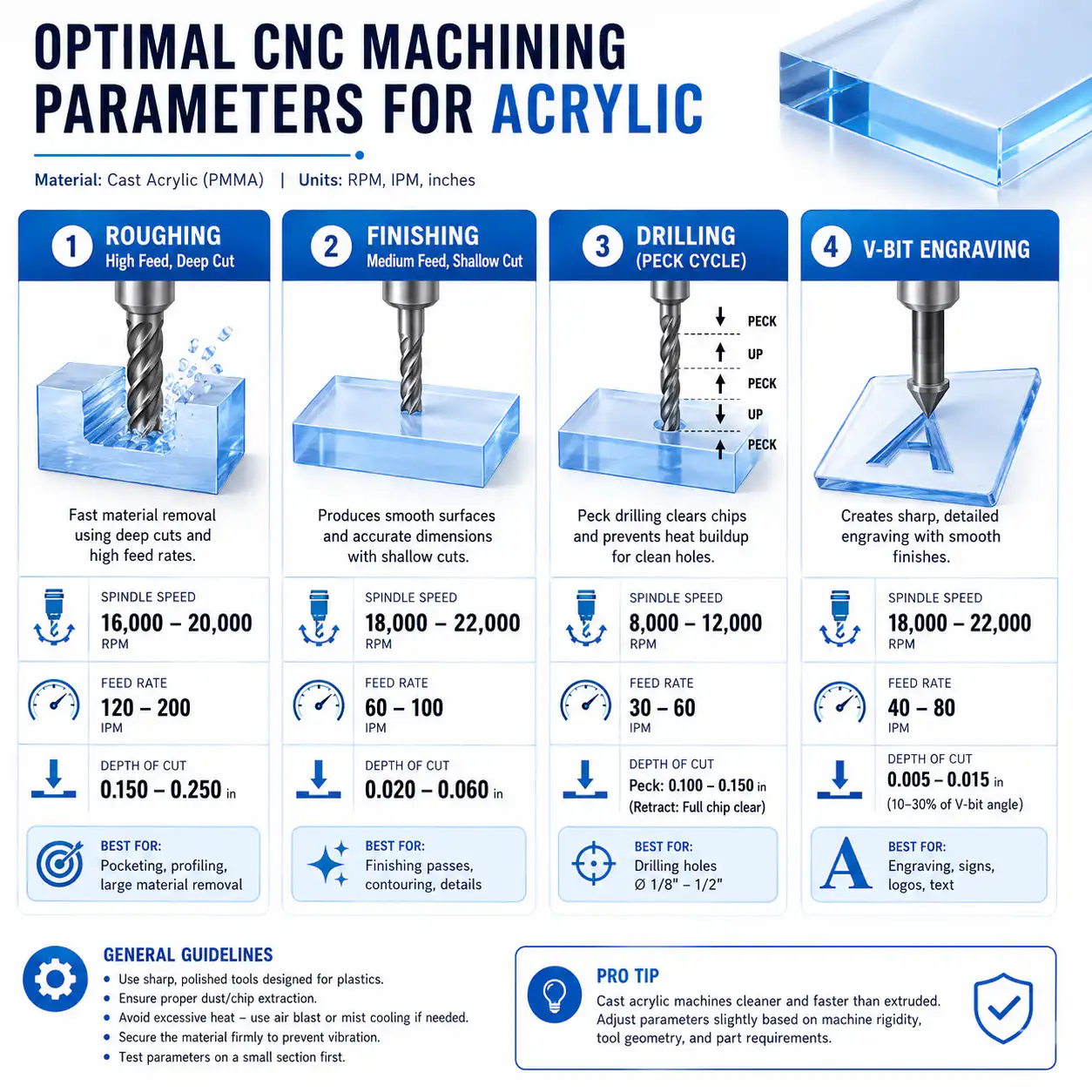
| Werking | Hulpmiddel | Speed (RPM) | Voedingssnelheid (mm/min) | Depth of Cut (mm) | Koelvloeistof |
|---|---|---|---|---|---|
| Voorbewerking | 2-flute carbide EM | 12,000-18,000 | 800-1,500 | 1.0-2.0 | Air blast + mist |
| Afwerking | 2-flute carbide BN | 15,000-20,000 | 400-800 | 0.2-0.5 | Mist only |
| Boren | Carbide twist drill | 3,000-6,000 | 100-300 | Peck 1-2mm/peck | Mist + peck cycle |
| Engraving | Single-flute 30° | 18,000-24,000 | 200-500 | 0.05-0.15 | Air blast |
| Draadsnijden | Hardmetalen draadfrees | 6,000-10,000 | Spiraalvormig | 0,1-0,2 per doorgang | Mist lubricant |
Design Rules for CNC Machining Acrylic
- Minimum wall thickness 1.5 mm: Thinner walls vibrate under cutting forces and crack. For unsupported walls over 10 mm tall, increase minimum to 2.5 mm. Use ribs and gussets rather than thicker walls for stiffness.
- Internal corner radius ≥ 0.5 mm: Sharp internal corners concentrate stress and initiate cracks during machining. Even a 0.5 mm radius distributes load and allows the tool to transition smoothly. For optical parts, specify 1.0 mm minimum to avoid visible stress marks.
- Tool engagement below 30% diameter: Keep radial engagement below 30% of tool diameter for finishing passes. Full slotting generates excessive heat in acrylic, causing melting and chip welding. Use trochoidal toolpaths for deep slots instead of straight plunging.
- Fixturing without point stress: Use vacuum chucks for flat parts or soft jaw vises with full-contact pads. Never clamp acrylic with steel jaws directly — even with soft metal shims. Point loading creates micro-cracks that propagate during machining. Double-sided tape works for thin sheets but limits DOC.
- Threads: coarse pitch, no tapping: Thread milling produces cleaner threads than tapping in acrylic. Use UNC or metric coarse pitch (min M3). Thread depth limit: 1.5× diameter. Taps bind in acrylic and cause thread stripping — avoid them entirely for production parts.
- Annealing for stress relief: Pre-machine annealing at 80°C for 1 hour per 25 mm thickness, then slow cool at 15°C/hour relieves internal stress. Post-machine annealing is less effective — the stress is already locked in at machined edges. Critical for parts with thin walls or multiple pockets.
Toepassingsmatrix voor de industrie
| Industrie | Standaardonderdelen | Materiaal/Kwaliteit | Belangrijkste vereiste |
|---|---|---|---|
| Optics & Lenses | Light pipes, prisms, sensor windows | Cast PMMA, optical grade | <0.05 μm Ra surface, no internal haze |
| Medical & Lab | Microfluidic chips, cuvettes, manifolds | USP Class VI cast acrylic | Chemical resistance, autoclavable (limited cycles) |
| Retail & Display | Point-of-sale stands, signage, trophy components | Cast or extruded (non-critical) | Flame-polished edges, 3D engraving clarity |
| Industrial Fluid | Sight glasses, flow indicators, filter housings | Cast acrylic, UV-stabilized | Pressure rating, solvent-bond compatible edges |
Kostenbeslissingskader
Acrylic CNC machining is used when parts need optical clarity, precision geometry, and cleaner edges than molded PMMA can provide.
Materiaalkosten: Cast acrylic sheet is $12-18/kg (6-12 mm thickness); extruded is $8-12/kg. The price difference narrows for thicker sheets (>20 mm) where cast is the only option.
Acrylic CNC machining is used when parts need optical clarity, precision geometry, and cleaner edges than molded PMMA can provide.
Machining cost drivers: Acrylic machines 30-50% slower than aluminum due to lower feed rates and depth of cut limits. Complex 3D contours add 40-60% to machining time versus 2.5D prismatic features. Flame polishing adds $2-5 per visible edge for manual work.
Acrylic CNC machining is used when parts need optical clarity, precision geometry, and cleaner edges than molded PMMA can provide.
Beslissingsregel: For production volumes above 500 pcs, injection molding acrylic (PMMA) beats CNC on per-part cost at $1.50-4.00 vs $8-25 for machined. But CNC wins for 1-200 pcs, prototypes, and parts requiring optical-grade surface quality that molding cannot consistently deliver.
Veelvoorkomende storingen en oplossingen
| Defect | Uiterlijk | Oorzaak | Oplossing |
|---|---|---|---|
| Cracking / chipping | Fracture at edges or corners during cut | Tool runout >0.01mm; excessive DOC; extruded acrylic stress | Use cast acrylic; verify tool runout <0.005mm; reduce DOC 50% |
| Melting / gumming | Chips weld to tool or workpiece surface | Insufficient cooling; RPM too high for feed rate | Add mist coolant; reduce RPM 20% or increase feed to clear chips |
| Poor surface finish | Cloudy, hazy, or frosted machined surface | Dull tool; wrong tool coating (TiN sticks to acrylic) | Use sharp polished carbide (uncoated or DLC only); fresh tool for finish pass |
| Maatonnauwkeurigheid | Part measures out of tolerance after unclamping | Part deformed under clamping pressure; thermal expansion | Use vacuum fixturing; allow part to cool 5-10 min before measurement |
Waarom zou u voor uw project kiezen voor nylonkunststof?
Precisieproductie
Acrylic CNC machining is used when parts need optical clarity, precision geometry, and cleaner edges than molded PMMA can provide.
Meer dan 30 CNC- en spuitgietcellen onder één dak
ISO 9001:2015-gecertificeerd
Acrylic CNC machining is used when parts need optical clarity, precision geometry, and cleaner edges than molded PMMA can provide.
Gecertificeerd kwaliteitssysteem, volledige inspectierapporten
Levertijd van 15-25 dagen
Acrylic CNC machining is used when parts need optical clarity, precision geometry, and cleaner edges than molded PMMA can provide.
Snelle levering, met mogelijkheden voor spoedverzending
Wereldwijde verzending
Acrylic CNC machining is used when parts need optical clarity, precision geometry, and cleaner edges than molded PMMA can provide.
Lucht- en zeevracht naar Noord-Amerika, Europa en Azië
Download Our Acrylic CNC Machining Guide
Acrylic CNC machining is used when parts need optical clarity, precision geometry, and cleaner edges than molded PMMA can provide.
Gratis PDF-referentiegids met technische gegevens, ontwerpregels en checklists voor leveranciers.
Acrylic CNC machining is used when parts need optical clarity, precision geometry, and cleaner edges than molded PMMA can provide.
Verwante artikelen
Veelgestelde vragen
Cast vs extruded acrylic — which is better for CNC machining?
Acrylic CNC machining is used when parts need optical clarity, precision geometry, and cleaner edges than molded PMMA can provide.
Cast acrylic is superior for CNC machining in nearly all cases. It has lower internal stress, higher molecular weight, better chip formation, and a higher softening temperature (~115°C vs ~105°C). Extruded acrylic can work for simple 2D profiling on thick sheets (>10 mm) where stress is less of an issue, but expect more scrap and lower surface quality on fine features.
How do I prevent acrylic from cracking during CNC machining?
Acrylic CNC machining is used when parts need optical clarity, precision geometry, and cleaner edges than molded PMMA can provide.
Five key factors: (1) Always use cast acrylic, not extruded. (2) Use sharp carbide tools with less than 0.01 mm runout. (3) Keep depth of cut conservative — 1-2 mm for roughing, 0.2-0.5 mm for finishing. (4) Avoid point-load clamping; use vacuum chucks or soft jaws. (5) Pre-anneal at 80°C for stress-critical parts. Cracking usually traces back to tool condition or fixturing, not the material itself.
What is the best coolant for CNC machining acrylic?
Acrylic CNC machining is used when parts need optical clarity, precision geometry, and cleaner edges than molded PMMA can provide.
A light mist of water-soluble coolant provides the best balance of cooling, chip evacuation, and surface finish. Avoid flood coolant — acrylic absorbs water and swells slightly, affecting dimensional accuracy. For engraving and light cuts, compressed air blast alone is sufficient. Never machine acrylic dry at production speeds — the heat buildup causes melting within seconds. Alcohol-based coolants can craze the surface and should be avoided.
How do you achieve optical clarity on machined acrylic surfaces?
Acrylic CNC machining is used when parts need optical clarity, precision geometry, and cleaner edges than molded PMMA can provide.
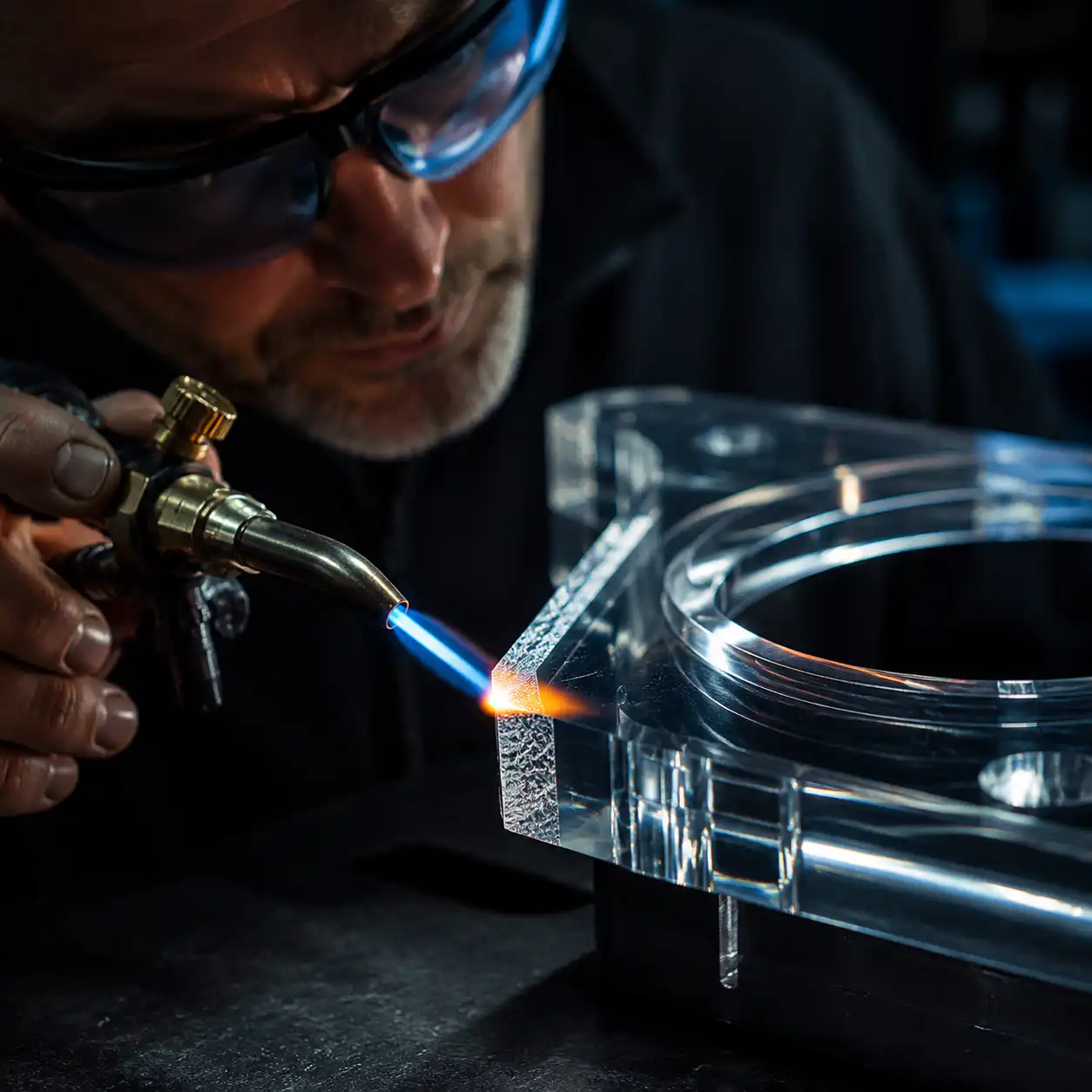
Post-machining polishing is needed for true optical clarity. The workflow: (1) Machine with finishing pass at 0.2 mm DOC using a new polished carbide tool. (2) Wet sand with 600 → 1200 → 2000 grit progressing in small increments. (3) Buff with a soft cotton wheel and fine polishing compound. (4) For edges, flame polishing with a hydrogen-oxygen torch produces glass-like clarity in one pass — but requires practice to avoid overheating. Diamond-turned surfaces on a lathe can achieve optical finish directly without secondary polishing.

