
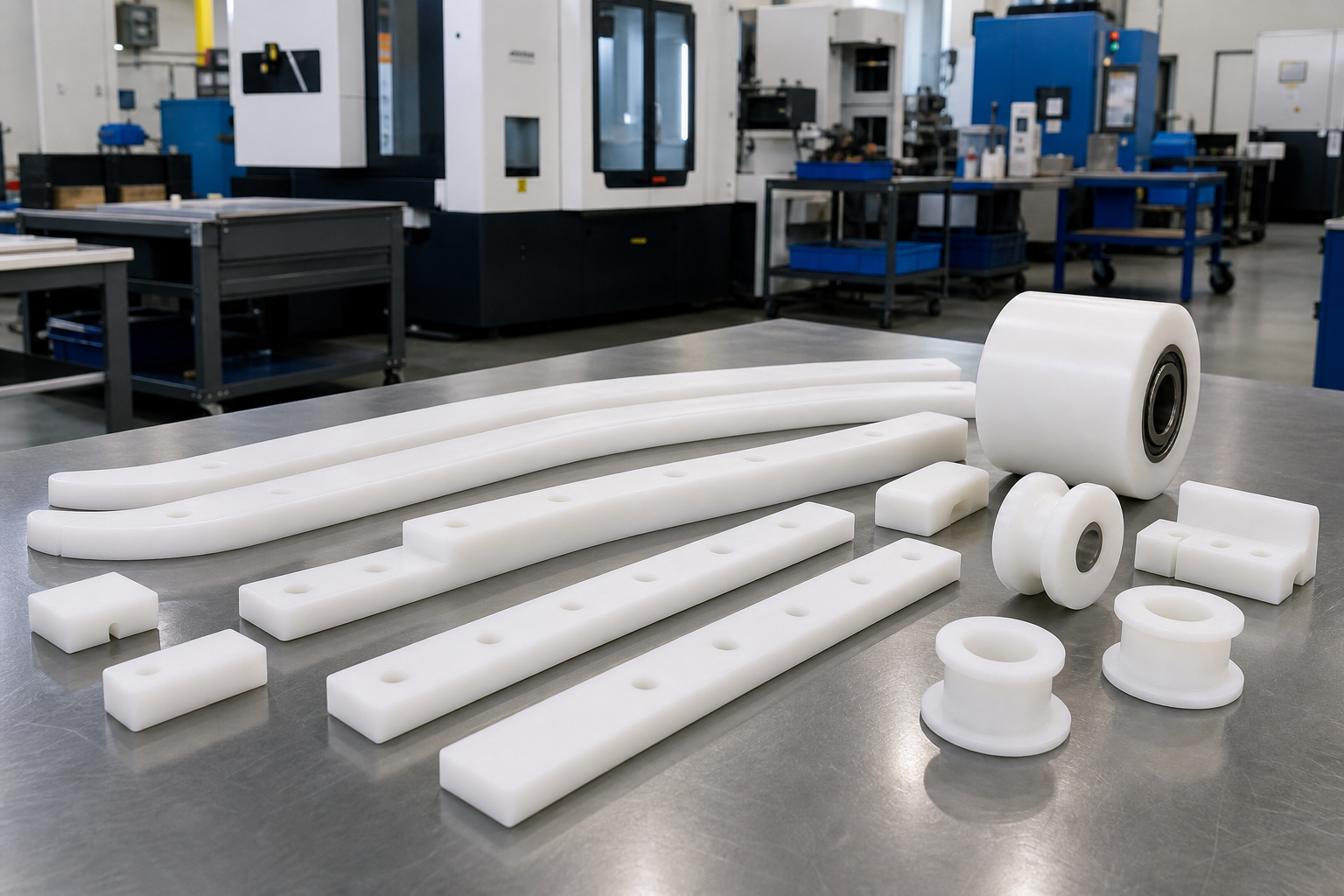
uhmw cnc machining services support low-friction, impact-resistant parts such as wear strips, chain guides, rollers, pads and bushings. UHMW-PE is attractive because it slides well and resists abrasion, but it does not machine or measure like a rigid metal.
A reliable quote therefore starts with the operating load, mating surface, temperature and realistic tolerance. The best result is usually a functional wear component, not a drawing filled with unnecessary close dimensions.
For conveyor, packaging and industrial equipment buyers
When Machined UHMW Is the Right Choice
Choose machined UHMW when low friction, impact absorption and wear life matter more than high stiffness or elevated-temperature performance.
- Best fit: guides, wear pads, rollers, chute liners and sacrificial contact parts
- Design priority: control functionally critical fits while allowing for thermal movement
- Commercial priority: compare machined sheet or rod with molded parts only after volume stabilizes
In één oogopslag
| Beslissingsmoment | UHMW Takeaway | Opmerking voor de koper |
|---|---|---|
| Wear and sliding | Excellent for many dry-running contact surfaces | Confirm load, speed and mating material |
| Slagvastheid | Strong, especially at lower temperatures | Useful for guards, stops and handling equipment |
| Dimensional stiffness | Lower than POM, PET or PEEK | Avoid metal-like tolerance assumptions |
| Temperature response | Expansion can be significant | State operating and inspection temperature |
| Typical process | CNC routing, milling and turning from sheet or rod | Stock form affects cost and yield |
Why UHMW Machining Needs a Functional Tolerance Strategy
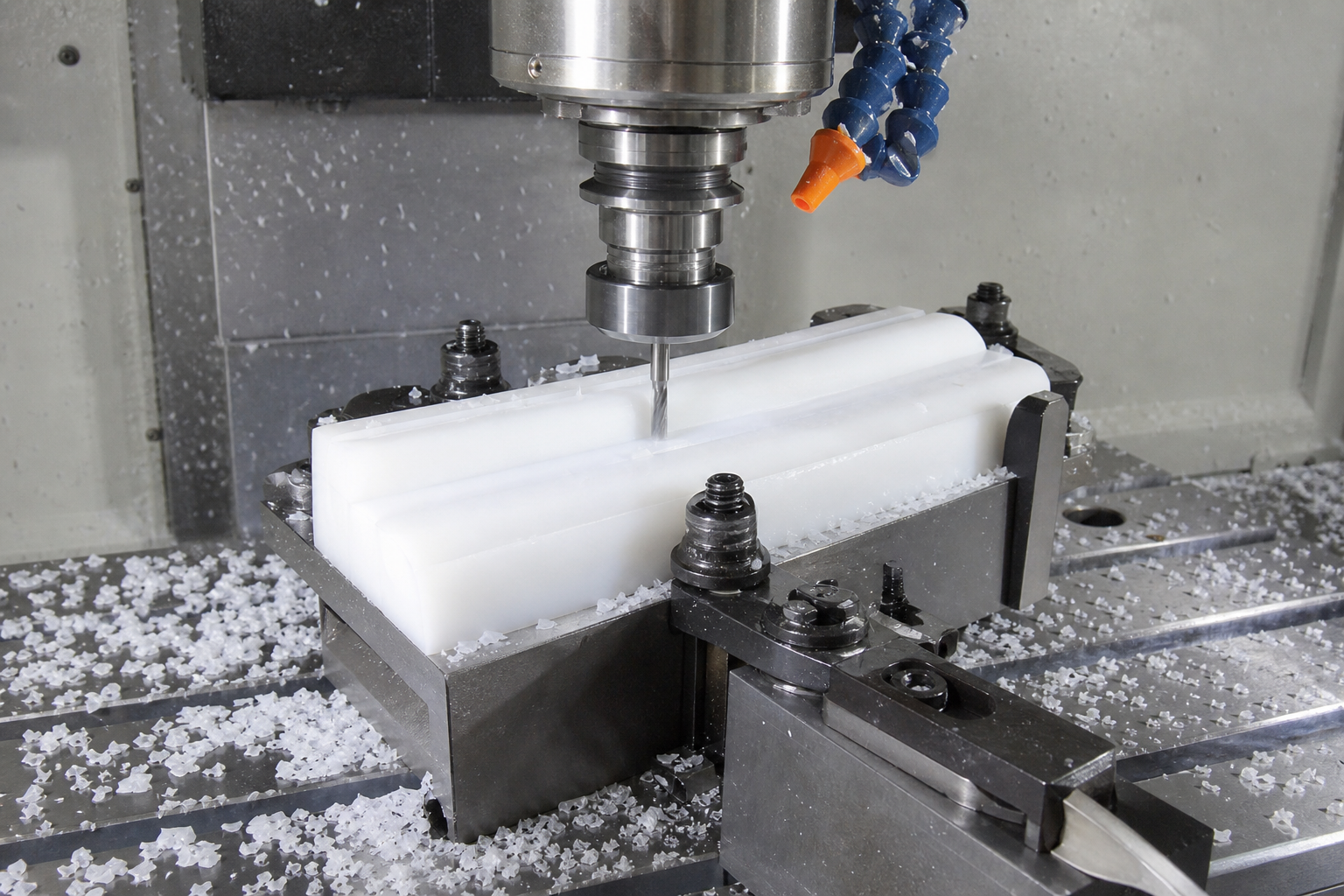
UHMW is tough but flexible. Excess clamp pressure can distort the blank, while heat from cutting can influence dimensions. Sharp tools, positive cutting geometry, chip clearance and low-stress workholding help maintain shape.
Thin walls, long unsupported sections and deep pockets are more likely to move after release. Critical holes and mating faces should be identified on the RFQ so the supplier can prioritize those features instead of applying the same tolerance everywhere.
RFQ Checklist for UHMW Machined Parts
- State the wear pair: identify the mating material, surface condition and whether lubrication is allowed.
- Share load and speed: sliding pressure and duty cycle affect the material decision.
- Mark critical dimensions: separate functional fits from noncritical profile dimensions.
- Define the environment: temperature, washdown, food contact and chemical exposure may change the grade.
- Include annual quantity: recurring demand can justify nesting, dedicated fixtures or another process.
Application and Manufacturing Matrix
| Toepassing | Recommended Direction | Important RFQ Detail |
|---|---|---|
| Conveyor chain guide | Machined virgin or reprocessed UHMW profile | Chain type, speed, mounting and wear allowance |
| Wear pad or liner | CNC-cut sheet with countersinks or slots | Contact pressure and replacement interval |
| Roller or bushing | Turned UHMW rod or tube | Shaft fit, load, speed and temperature |
| Food handling component | Qualified food-contact grade where required | Cleaning method and documentation target |
Common Project Risks and Practical Fixes
| Risico | Waarom dit gebeurt | Praktische oplossing |
|---|---|---|
| Part measures differently after unclamping | Flexible stock was distorted during machining | Use low-stress fixtures and inspect after stabilization |
| Hole or bore fit changes in service | Thermal expansion and creep were ignored | Design clearance around real operating conditions |
| Poor surface or stringy chips | Tool geometry and chip evacuation are unsuitable | Use sharp positive tools and controlled cutting parameters |
| UHMW wears too quickly | Load, speed or mating surface exceeds the application window | Compare POM, PET, nylon or filled wear grades |
UHMW vs HDPE, Nylon and POM for Machined Parts
UHMW generally offers better sliding and impact behavior than standard HDPE, while HDPE can be easier to source for structural tanks, panels and less demanding components. Nylon and POM are stiffer and often hold closer fits, but they create different moisture, friction and cost tradeoffs.
The correct choice depends on whether the part is primarily a wear surface, a precision locating component or a structural element. A supplier should screen that function before confirming UHMW.
Need a wear-part review before quoting?
Send the drawing, mating surface, load, speed, temperature and annual quantity. We can review whether UHMW is suitable and identify the dimensions that need process control.
Waarom kiezen voor nylon?
Nylon Plastic combines engineering-plastic selection with CNC manufacturing review. Buyers receive a practical recommendation covering grade, stock form, machining route and inspection instead of a material-only quotation.
Gerelateerde lezen
- HDPE vs UHMW-PE Comparison
- CNC Plastic Milling Services
- Op maat vervaardigde kunststof onderdelen
- Plastic Bearing Materials Guide
UHMW Grade and Stock Form Define the Starting Point
UHMW CNC machining services must account for the material’s low stiffness, high thermal expansion and creep. Virgin, reprocessed, antistatic, oil-filled, glass-filled, UV-stabilized, detectable and compliance-qualified grades should not be substituted without approval. Sheet flatness, extrusion or compression-molded stock condition, color and lot documentation can affect both machining behavior and final acceptance.
Supportive Workholding and Low-Heat Machining
Fixtures should support broad areas rather than concentrate clamp force at a few points. A flexible plate can look flat while restrained and spring back after release. Sharp tools, generous chip clearance and controlled cutting heat reduce smearing and dimensional drift. Large wear strips and guides benefit from balanced machining on both faces and time to stabilize between roughing and finishing.
UHMW Feature, Risk and Inspection Matrix
| Part Feature | Main Risk | Manufacturing Direction | Inspection Direction |
|---|---|---|---|
| Long wear strip | Bow, thermal growth and mounting mismatch | Use realistic length tolerance and mounting-hole strategy | Defined supports plus functional installation check |
| Guide channel | Wall flex and cutter deflection | Support the channel and finish critical faces together | Functional gauge or mating-component check |
| Large plate | Stock flatness and restraint-dependent readings | Define free-state condition and mounting scheme | Fixture method, temperature and support points recorded |
| Threaded joint | Creep and thread stripping | Use through-bolts, inserts or load-spreading features where appropriate | Assembly torque and retention test when critical |
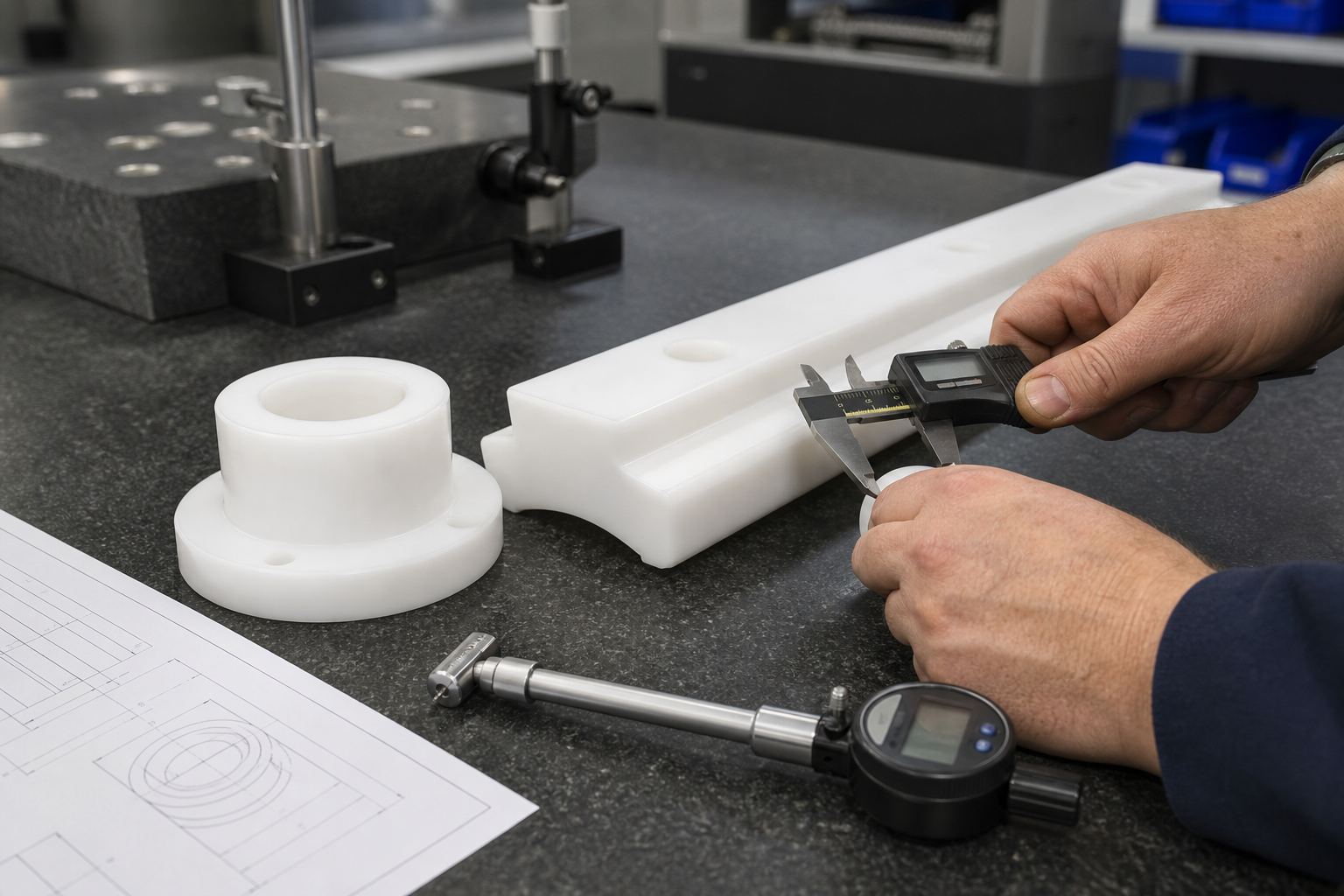
UHMW tolerances should follow function. Bearing clearances, conveyor alignment, bolt slots and wear allowance may be more important than cosmetic edge dimensions. Avoid copying metal tolerances onto flexible UHMW geometry without considering temperature range, mounting constraint and service load.
Stabilization, Burrs and Surface Expectations
Traditional annealing is not a universal solution for UHMW. Dimensional control usually relies on stable stock, balanced material removal, low heat input and sufficient time between operations. Specify edge condition and burr limits because a polished-looking surface may not improve wear performance, while aggressive manual finishing can change a functional profile.
UHMW RFQ and Acceptance Checklist
- Exact grade, stock form, color, compliance and certificate requirements.
- CAD, drawing, installation supports, mating surfaces and wear direction.
- Load, speed, impact, temperature, chemicals and cleaning method.
- Critical clearances, free-state measurement rules and functional gauges.
- Quantity, replacement interval, packaging, traceability and inspection report.
Compare quotes using the same grade, stock thickness, machining allowance, inspection condition and packaging scope. For replacement wear components, provide a used sample or assembly information when the drawing does not fully describe the functional interface.
UHMW Machining Decisions That Affect Fit and Wear
| Decision | Risk If It Is Missed | What to Define |
|---|---|---|
| Grade and stock form | Wear, impact, food-contact or dimensional expectations do not match the stock | Exact UHMW grade, plate or rod, color, certificate and backup material |
| Fit and clearance | Low stiffness and thermal expansion create binding or excessive play | Load, speed, temperature, mating material, clearance and inspection state |
| Workholding and heat | Clamping or cutting heat distorts the part after release | Nesting, soft jaws, cutting strategy, rest time and measurement condition |
| Wear route | UHMW is selected where a stiffer nylon or POM part would hold a closer fit | Compare friction, abrasion, impact, stiffness, moisture and service life |
UHMW-PE is an unmodified polyolefin option for low-friction and impact-resistant wear parts. It is not a direct substitute for modified nylon pellets. When the part needs higher stiffness, creep control, temperature capability, or a different manufacturing route, compare the exact requirement with unfilled PA, PA-GF20, PA-CF30, POM, or another qualified material.
Hoe nylonplastic het project ondersteunt
Nylon Plastic has supported material selection and finished plastic-part manufacturing since 2005. For UHMW CNC machining and plastic wear-part selection, the useful review connects the drawing, material, tooling or machining route, inspection state, and production plan before a quote is approved.
- Review UHMW against nylon and other plastics using load, speed, temperature, friction, impact, moisture, fit, and expected wear rather than a generic material label.
- Plan workholding, low-heat cutting, stabilization, inspection, packaging, and mating-part checks for the actual geometry.
- Use CNC machining for custom wear parts and compare an unfilled or reinforced nylon route when stiffness or dimensional control is the limiting need.
Veelgestelde vragen
What parts are suitable for UHMW CNC machining?
UHMW is commonly considered for wear strips, guides, pads, rollers, bushings, plates, and low-friction components when impact and abrasion behavior fit the application.
What tolerances are realistic for machined UHMW?
There is no universal tolerance. Geometry, stock, temperature, clamping, toolpath, rest time, measurement method, and service clearance determine what is practical.
Is UHMW better than nylon for wear parts?
Not universally. UHMW can provide low friction and impact resistance, while nylon may offer more stiffness, temperature capability, or dimensional control. Compare the actual load and environment.
What should a UHMW CNC RFQ include?
Send the drawing, stock or grade, application, load, speed, temperature, mating material, quantity, critical fits, surface needs, inspection, packaging, and any food-contact or compliance requirement.
Request a UHMW CNC Machining Review
Send the drawing, grade, application, load, speed, quantity, and critical fits for a material and machining review.

