
aerospace plastic machining turns qualified engineering-plastic stock into brackets, insulators, housings, guides, spacers and test components without injection-mold tooling. The process is most useful for prototypes, low-to-medium volumes, complex geometry and programs that require controlled material and inspection records.
The word aerospace does not make a part flight-approved. The buyer must define the aircraft or ground-support application, drawing revision, material specification, traceability level, inspection plan and any regulatory or program-specific requirement before a supplier confirms the route.
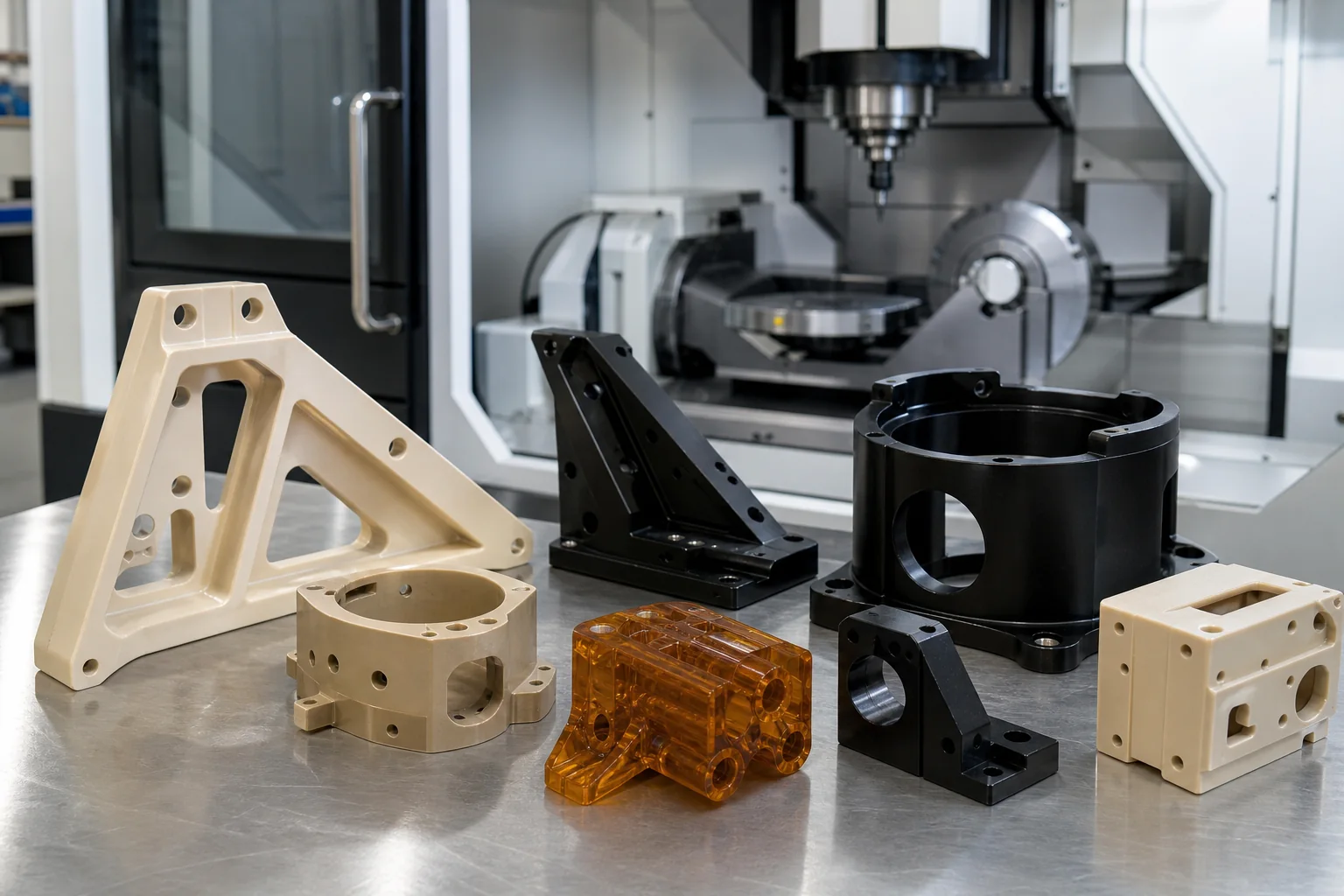
For aerospace, UAV, avionics and ground-support buyers
When CNC-Machined Plastic Is the Right Route
Choose CNC machining when geometry, documentation and revision flexibility matter more than the unit-cost advantage of a dedicated mold.
- Best fit: prototypes, replacement geometry, fixtures, insulators and controlled low-volume components
- Material priority: select from the actual temperature, chemical, electrical, wear and flammability requirements
- Quality priority: agree on material lot records, drawing revision and inspection deliverables before purchase order release
Aerospace Machining Decision Summary
| Beslissingsmoment | Machining Takeaway | Opmerking voor de koper |
|---|---|---|
| PEEK | High-temperature and chemical-performance option for demanding components | Confirm exact grade, stock form and required certification documents |
| PEI | Useful where stiffness, electrical behavior and qualified flame/smoke performance matter | Do not assume every PEI grade meets the same program requirement |
| PPS | Dimensionally stable option for heat and chemical exposure | Review brittleness, wall sections and edge geometry |
| POM or nylon | Cost-effective for selected interior, mechanism, fixture or ground-support uses | Check moisture, temperature, flammability and program restrictions |
| Inspectie | Critical dimensions can be controlled without assigning close tolerance everywhere | State datum scheme, inspection temperature and report format |
How Aerospace Plastic CNC Machining Differs from General Job-Shop Work
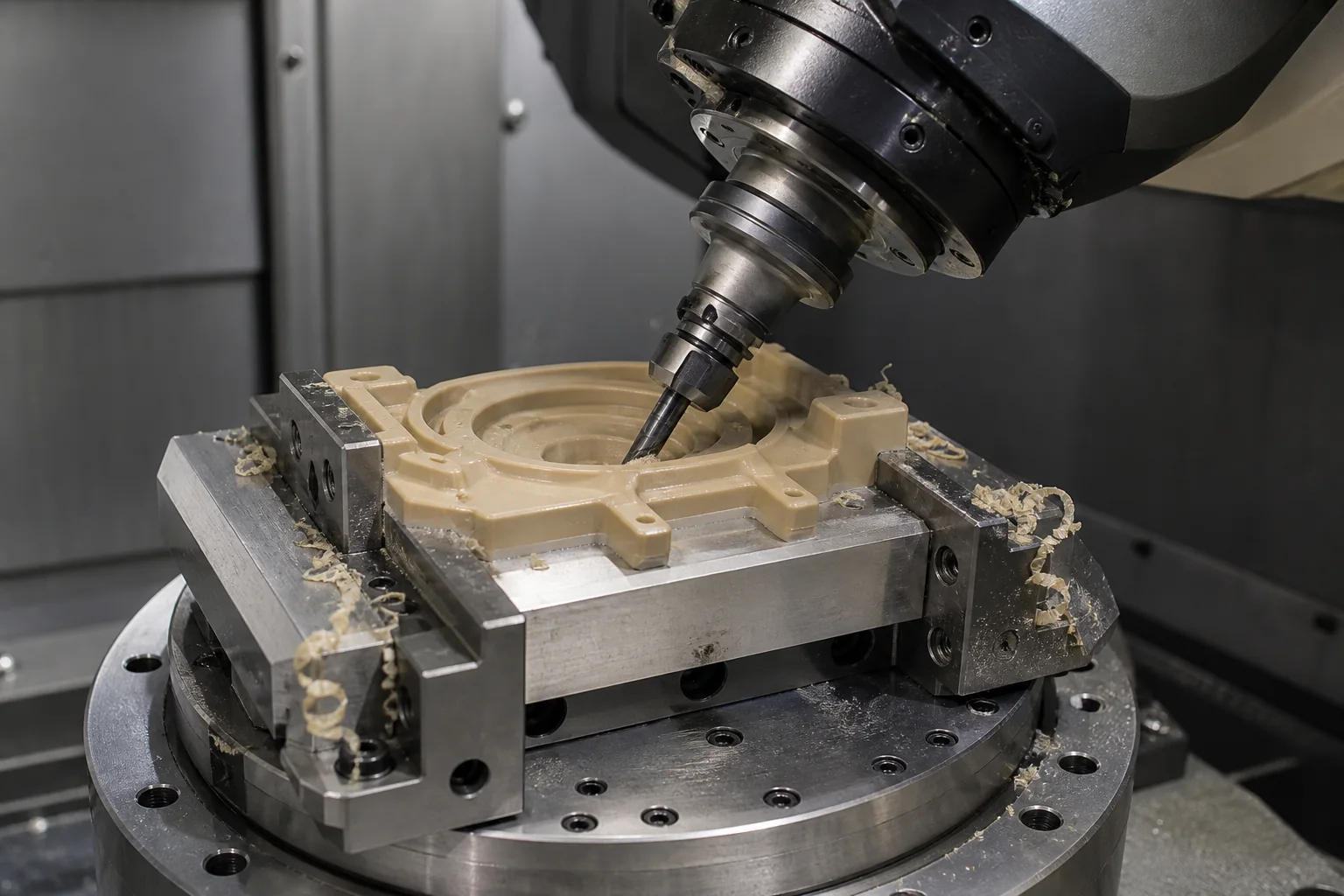
Engineering plastics respond to clamp pressure, cutting heat, moisture and internal stress differently from aluminum. Sharp tools, supported workholding, balanced material removal and suitable intermediate inspection help protect geometry. Thin walls, deep pockets and long unsupported features require special attention because the part may move after unclamping.
Stock identity is part of the manufacturing plan. The quote should identify the resin or stock-shape specification, manufacturer and grade when required, plus whether a certificate of conformance, material test report, lot traceability or supplier declaration is needed. Substitution should never occur without written approval when a program controls the material source.
De FAA guidance on aeronautical replacement parts emphasizes quality, eligibility and traceability. For spacecraft or vacuum hardware, material screening may also include outgassing evidence; NASA describes the ASTM E595 method in its outgassing database guide. These references do not automatically qualify a machined part, but they show why requirements must be defined before manufacturing.
Aerospace Plastic Machining RFQ Checklist
- Drawing control: provide the released drawing, 3D model, revision and a clear precedence rule if files conflict.
- Application status: state whether the part is flight, cabin, UAV, test, tooling or ground-support hardware.
- Material definition: specify polymer, grade, color, stock manufacturer and approved alternatives.
- Traceerbaarheid: define lot tracking, certificate of conformance, material report and record-retention needs.
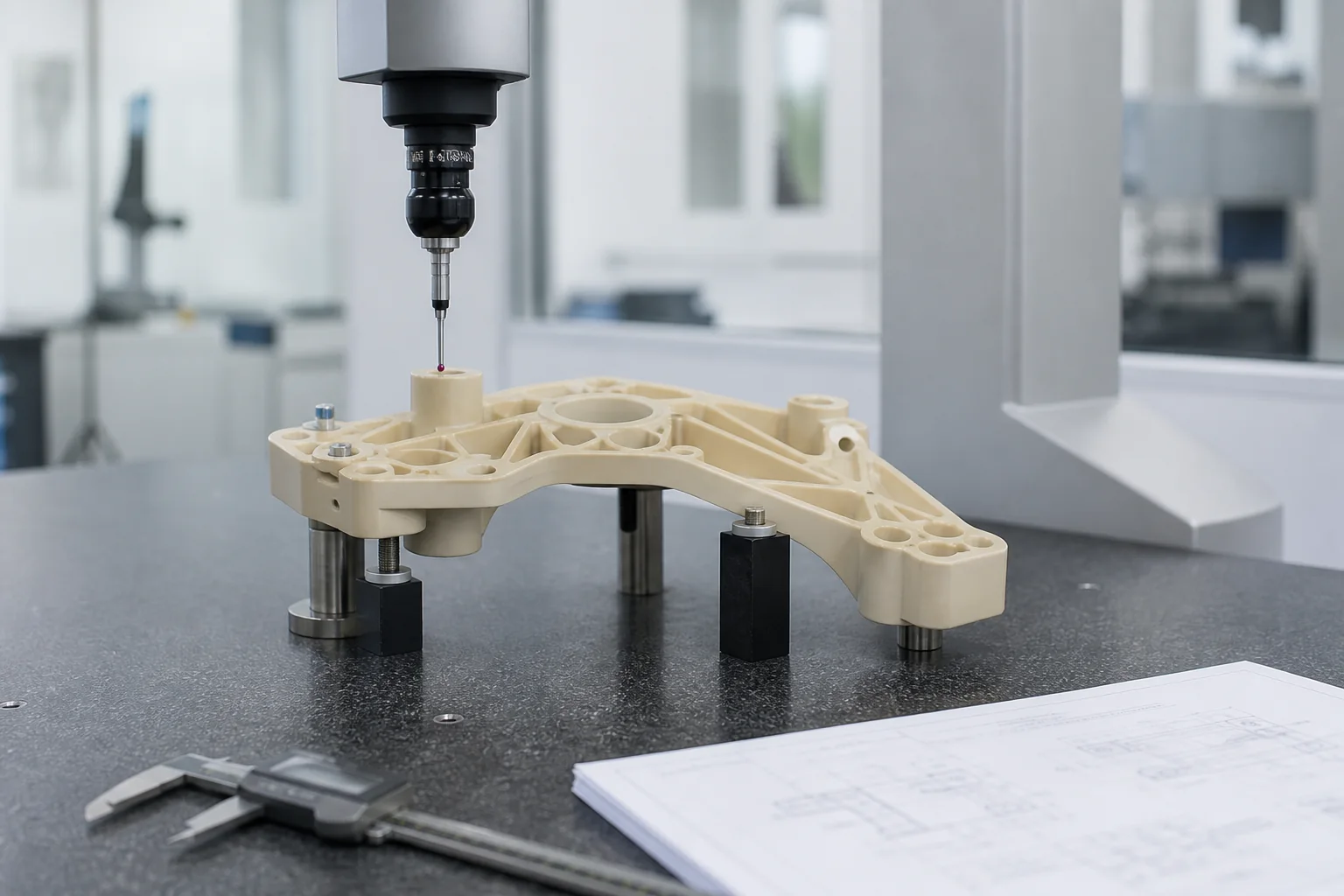
- Inspection: mark critical dimensions, datums, sampling level, first-article format and any CMM report requirement.
- Handling: include cleanliness, marking, packaging, sharp-edge and contamination restrictions.
- Commercial data: share prototype quantity, annual demand, delivery schedule and expected revision stage.
Application and Material Matrix
| Toepassing | Material Direction | RFQ Detail to Confirm |
|---|---|---|
| Avionics insulator or housing | PEEK, PEI or another electrically suitable qualified grade | Voltage, temperature, flame/smoke and cleanliness requirements |
| Structural bracket or spacer | PEEK, PEI, PPS or reinforced grade after load review | Load case, creep, fasteners, wall sections and critical datums |
| Low-friction guide or wear part | Filled PEEK, PTFE-based grade, POM or nylon depending environment | Load, speed, mating surface, lubrication and temperature |
| UAV payload component | Lightweight polymer selected from stiffness and environment | Vibration, temperature, UV, mass target and assembly interfaces |
| Jig, fixture or ground-support component | POM, nylon, PEI, PEEK or plate material based on function | Service life, contact surfaces, calibration and replacement plan |
Common Project Risks and Practical Fixes
| Risico | Waarom dit gebeurt | Praktische oplossing |
|---|---|---|
| Material document is rejected | The quote did not define grade, lot or report requirements | Approve the material and documentation package before stock purchase |
| Part moves after machining | Clamp stress, heat or unbalanced stock removal changed geometry | Use supported workholding, staged machining and stabilization where needed |
| Inspection results disagree | Temperature, datum setup or measurement method differs | Agree on datum simulation, conditioning and report method |
| Close tolerance drives unnecessary cost | Metal-like tolerances were copied to noncritical plastic features | Classify dimensions by function and protect only true interfaces |
| Supplier implies certification not held | Marketing language was accepted instead of project evidence | Request the exact quality-system scope and required records before award |
CNC Machining vs Injection Molding and Additive Manufacturing
CNC machining uses commercial stock and avoids mold lead time, making it practical for low volumes, revision-heavy programs and parts that need machined surfaces or tight local features. Injection molding can lower unit cost after geometry, material, validation and demand are stable, but tooling and process qualification require a larger commitment.
Additive manufacturing can accelerate fit checks, ducts and complex internal geometry. It is not automatically interchangeable with machined stock because anisotropy, porosity, surface condition and material documentation differ by process. The buyer should compare the actual acceptance criteria rather than choosing a process from shape alone.
Need a manufacturability and documentation review?
Send the drawing, application status, material specification, quantity, critical dimensions and required records. We will identify open questions before preparing a quote.
Waarom kiezen voor nylon?
Established in 2005, Nylon Plastic supports engineering-plastic selection, CNC manufacturing and dimensional review for custom projects. We confirm the material, tolerances, inspection scope, documentation and delivery plan against the supplied drawing rather than presenting a generic aerospace certification claim.
Gerelateerde lezen
- Aerospace Plastic Molding Supplier Guide
- CNC Machining Materials Selection Guide
- Op maat vervaardigde kunststof onderdelen
- CNC Plastic Milling Services
Veelgestelde vragen
Welke kunststoffen worden doorgaans gebruikt voor CNC-bewerking in de lucht- en ruimtevaart?
PEEK, PEI, PPS, op PTFE gebaseerde soorten, POM en nylon kunnen in aanmerking komen, maar de juiste keuze hangt af van de precieze vereisten voor de vlucht, de cabine, de UAV, de test of de grondondersteuning.
Zorgt CNC-bewerking ervoor dat een kunststof onderdeel wordt goedgekeurd voor gebruik in de lucht- en ruimtevaart?
Nee. Goedkeuring of aanvaarding hangt af van de ontwerpbevoegdheid, de materiaalspecificaties, de controles door de leverancier, de inspectie, de traceerbaarheid en de geldende programma-eisen.
Welke traceerbaarheidsdocumenten kunnen worden opgevraagd?
Kopers kunnen een conformiteitscertificaat, een identificatie van de voorraad of de harspartij, een materiaaltestrapport, aankoopgegevens en inspectierapporten opvragen. De exacte samenstelling van het pakket moet vóór de productie worden overeengekomen.
Kunnen kunststof onderdelen voor de lucht- en ruimtevaart met nauwe toleranties worden bewerkt?
Belangrijke eigenschappen kunnen vaak worden geregeld, maar de tolerantie hangt af van het materiaal, de afmetingen, de wanddikte, het vochtgehalte, de temperatuur, de opspanstrategie en de meetmethode.
Wat moet er in een offerteaanvraag voor de bewerking van kunststof voor de lucht- en ruimtevaart worden opgenomen?
Vermeld de revisie van de tekening en het model, de status van de aanvraag, de materiaalspecificatie, de goedgekeurde leveranciers, de hoeveelheid, de kritische afmetingen, het inspectieplan, de documentatie en de verpakkingsvereisten.
For an aerospace plastic machining RFQ
Upload the drawing and list the application, grade, quantity, critical features, inspection reports and traceability documents required for supplier review.

