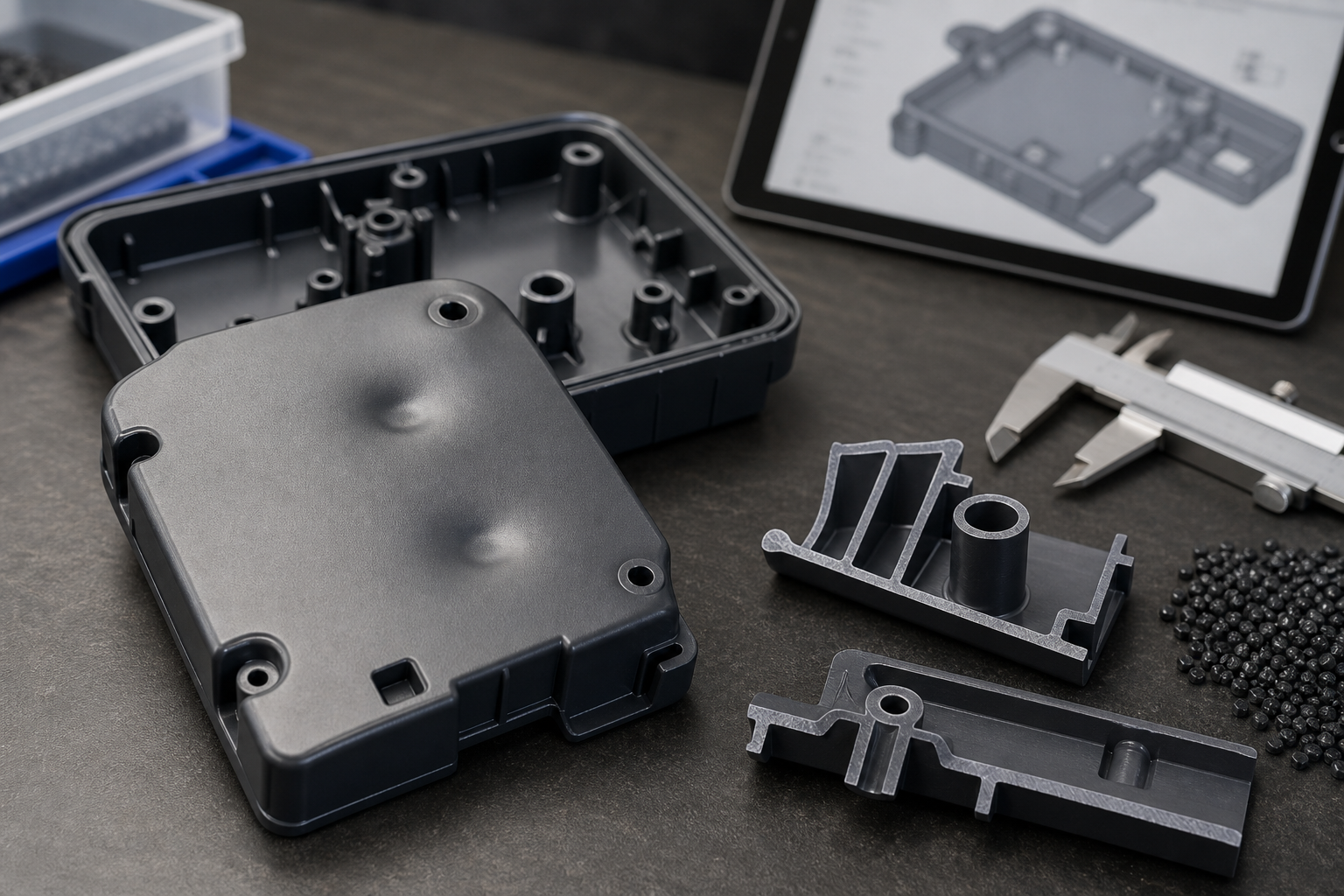
Zinkplekken bij spuitgieten zijn ondiepe kuiltjes op het oppervlak van het onderdeel die worden veroorzaakt door ongelijkmatige krimp, meestal op plaatsen waar dikke wanden, ribben, uitsteeksels, schroefpinnen of zware delen langzamer afkoelen dan het omringende materiaal. Om dit te verhelpen zijn doorgaans zowel een DFM-beoordeling als procesafstemming nodig.
Een spuitgietonderdeel kan aan de basisafmetingen voldoen en toch bij de visuele inspectie worden afgekeurd vanwege inzinkingen. Voor behuizingen, afdekkappen, auto-interieuronderdelen en onderdelen die in contact komen met de consument, moet het beheersen van inzinkingen al vóór het snijden van de matrijs worden gepland door middel van wandontwerp, ribverhoudingen, de plaatsing van de ingang en de vulstrategie.
Veelvoorkomende oorzaken van kuiltjes in het aanrecht
| Oorzaak / materiaal | Typisch kenmerk of gebruik | Maatregel van de koper of de technische dienst |
|---|---|---|
| Dikke wand | Vlakke verdieping boven een zware massa | Haal dikke delen weg en zorg ervoor dat de overgangen tussen de wanden geleidelijk verlopen |
| Extra grote ribben | Uitsparing tegenover de ribbasis | Zorg ervoor dat de ribdikte dunner is dan de nominale wanddikte |
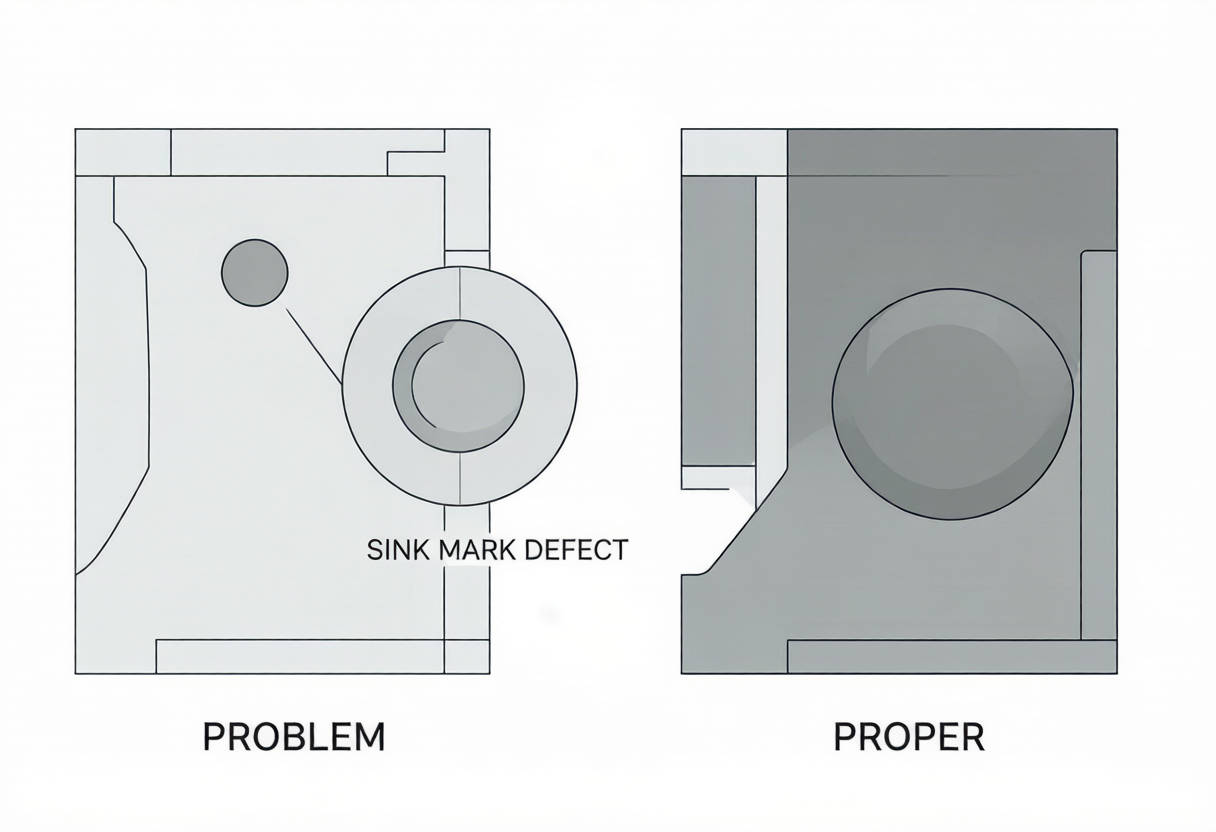
| Zware bazen | Ronde spoelbak op zichtbaar oppervlak | Gebruik steunribben en een goed ontworpen naaf |
| De poort sluit te vroeg | Slechte verpakking in dikke zones | Controleer de afmetingen van de poort, de locatie en de inpaktijd |
| Materiaal met hoge krimp | Meer zichtbare verzonking bij PP, PE of kristallijne harsen | Pas de DFM- en krimpverwachtingen aan per materiaal |
DFM-controles vóór de productie van de matrijzen
- Zorg ervoor dat de nominale wanddikte zo gelijkmatig mogelijk is.
- Vermijd abrupte overgangen van dunne wanden naar dikke profielen.
- Maak de ribben dunner dan de hoofdwand en voeg waar nodig een afronding toe.
- Boor de uitsteeksels uit in plaats van massieve stukken plastic achter te laten.
- Plaats poorten zo dat dikke zones kunnen worden gevuld voordat de poort wordt geblokkeerd.
Materiaalkrimp en het risico op verzakking
| Materiaal / behuizing | Belangrijkste punt van zorg | Toelichting bij de selectie |
|---|---|---|
| ABS | Matig risico op verzakking | Geschikt voor behuizingen wanneer de ribben en uitsteeksels correct zijn ontworpen |
| PC / PC-ABS | Matig risico | Cosmetische oppervlakken moeten worden gecontroleerd op spanning en verzakkingen |
| PP | Grotere krimp | Beheer zowel de wanddikte als de kromtrekking |
| POM | Kristalkrimp | Bekijk de precisiefuncties en de verpakking |
| Met glasvezel versterkt nylon | Vezeloriëntatie en differentiële krimp | Controleer ribben, uitsteeksels en kromtrekken |
Details van de offerteaanvraag van de koper voor het voorkomen van afdrukken in spoelbakken
Voor een nuttige beoordeling kunt u het 3D-model of de 2D-tekening, de harssoort of het beoogde materiaal, foto’s van het onderdeel (indien het defect al aanwezig is), informatie over de machine en de matrijs (indien beschikbaar), het verwachte jaarlijkse productievolume, esthetische eisen, kritische afmetingen, de toepassingsomgeving en eventuele inspectienormen toesturen. Nylon Plastic kan het ontwerp, het materiaal en het spuitgietproces beoordelen voordat er wijzigingen in de matrijzen of de productie worden doorgevoerd.
Diagnose van putjes op basis van kenmerken
| Kenmerk of patroon | Waarom het zinkt | Beoordeling van ontwerp of proces |
|---|---|---|
| Laat het over een rib zakken | De lokale massa koelt later af dan de zichtbare wand | De ribverhouding verkleinen, het profiel uithollen en controleren of de pakking bereikbaar is |
| Rond een eindbaas heen zakken | Het massieve kunststof rondom de paal zorgt voor een ongelijkmatig koeloppervlak | Gebruik een holle uitstulping, voldoende hellingshoek en een gecontroleerde wandovergang |
| Gootsteen aan het einde van de afvoer | De druk is afgenomen voordat het dichte gebied is samengeperst | Controleer de plaats van de poort, de balans van de kanalen, de houddruk en de bevriezingstijd |
| Veranderingen aan de spoelbak na vervanging van het materiaal | Krimp, viscositeit, versterking en conditionering zijn veranderd | Recheck the exact grade, filler direction, drying and shrinkage assumptions |
Higher packing pressure can hide a sink mark on one tool trial, but it may increase flash, stress, cycle time, or gate blush. A durable correction normally combines section design, gate access, cooling, material choice, and a validated packing window.
Hoe nylonplastic het project ondersteunt
Nylon Plastic has supported material selection and finished plastic-part manufacturing since 2005. For sink mark prevention on molded plastic parts, the useful review connects the drawing, material, tooling or machining route, inspection state, and production plan before a quote is approved.
- Review the visible surface, rib and boss geometry, material shrinkage, gate location, and expected conditioning state before tooling.
- Compare unfilled PA with PA-GF20 or PA-CF30 only when the structural and dimensional requirements justify the change in flow and anisotropy.
- Use sample parts, measured wall sections, cavity records, and defined cosmetic limits to close the DFM decision.
Gerelateerde lezen
Veelgestelde vragen
Wat veroorzaakt inzinkingen bij het spuitgieten?
Verzakkingen ontstaan meestal door ongelijkmatige volumekrimp in dikke delen, zoals ribben, uitstulpingen, massieve vlakken of abrupte wandovergangen. De verdichting, de koeling, het materiaal en de toegang van de ingang beïnvloeden het resultaat.
Kunnen deuken worden verwijderd door middel van druk tijdens het verpakken?
Als de poort lang genoeg open blijft staan, kan dit sommige inzakkingen verminderen, maar overmatige verdichting kan leiden tot bramen, spanning, kromtrekken of een langere cyclus. Pas de geometrie en het drukbereik gezamenlijk aan.
Welke materialen zijn gevoeliger voor inzinkingen?
Elke thermoplast kan inzakkingen vertonen wanneer de sectiemassa en de koeling onvoldoende worden geregeld. Het is raadzaam om de exacte kwaliteit, de versterking, de krimp, de vloeirichting en het verwerkingsvenster te controleren, in plaats van af te gaan op een algemene aanduiding.
Wat moet een DFM-beoordeling van een verzakking omvatten?
Gelieve het CAD-model, de wand- en ribkaart, de cosmetische zones, het materiaal of de reservekwaliteit, het ingietconcept, de jaarlijkse hoeveelheid, de tolerantie-eisen en foto’s of afmetingen van het defect aan te leveren.
Request a Sink Mark DFM Review
Send the part geometry, resin requirement, cosmetic zones, and target quantity for a design, tooling, and process review.

