
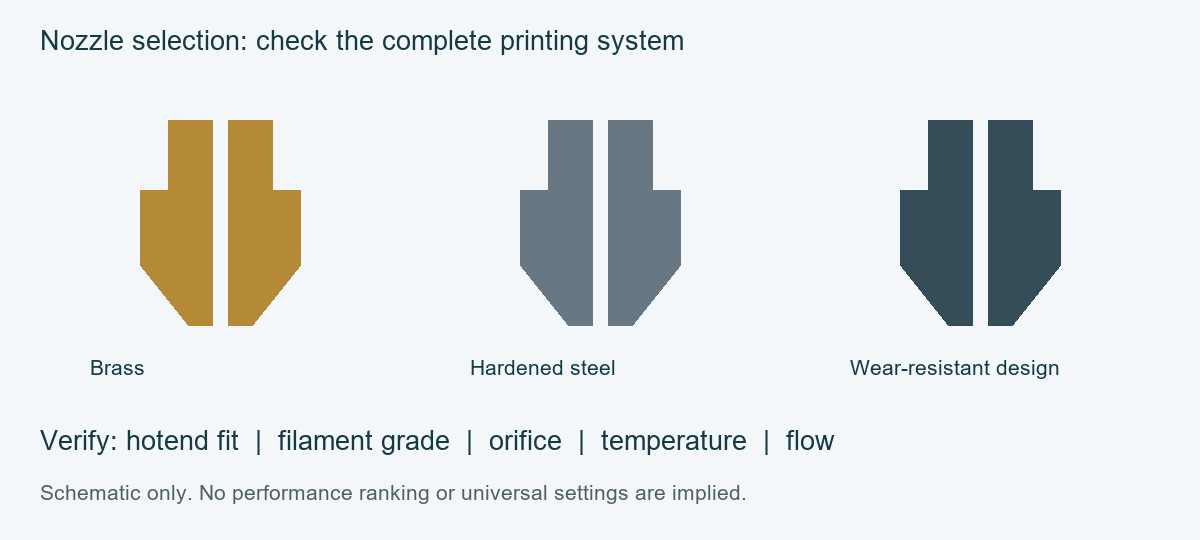
Kies 3D printing nozzle material for abrasive filaments by wear resistance, heat transfer and compatibility with the hotend. Carbon-fiber-filled, glass-fiber-filled and other particle-filled polymers can wear an unsuitable nozzle. A nozzle that fits mechanically is not automatically suitable for the filament or operating temperature.
Start with the Filament and Hotend Requirements
Record the exact filament grade, filler type, recommended nozzle material, minimum orifice, temperature range and drying instructions. Then check the printer manufacturer’s nozzle geometry, thread, sealing arrangement, heater and temperature limits. Use the lower applicable limit when the nozzle, hotend and filament requirements differ.
Compare Nozzle Material Options
| Optie | Overwegingen bij de selectie | Wat moet worden gecontroleerd |
|---|---|---|
| Messing | A common baseline for suitable unfilled filaments; abrasive service requires a separate wear assessment. | Whether the filament supplier permits it and how nozzle wear will be monitored. |
| Hardened steel | A wear-resistant option for compatible filled filaments. Recalibrate the process after changing nozzle construction. | Hotend fit, supplier temperature limits, extrusion consistency and filament compatibility. |
| Coated or composite wear-resistant nozzle | Combines material or coating choices to address abrasion and flow. Performance depends on the exact nozzle design. | Compatible printer models, approved cleaning method, orifice size and manufacturer performance data. |
| Other specialist nozzle constructions | Evaluate against the actual polymer, filler, throughput and replacement cost rather than a material-name ranking. | Manufacturer approval for the hotend and filament, service conditions and maintenance instructions. |
Nozzle Diameter and Fiber-Filled Filaments
Follow the filament manufacturer’s recommended minimum nozzle diameter. An orifice suitable for an unfilled polymer may not be suitable for a filled grade. Also review layer height, line width, flow demand and the required feature size. A larger nozzle changes achievable detail and process settings; it does not remove the need to dry moisture-sensitive nylon.
Validate the Change Before Printing Functional Parts
- Confirm nozzle and hotend compatibility before installation.
- Install and tighten using the manufacturer’s procedure and temperature guidance.
- Dry the filament according to its supplier instructions.
- Recheck extrusion, temperature, flow and first-layer behavior with a representative test.
- Measure critical features and inspect surface quality and layer bonding before approving the part.
- Record the nozzle model, diameter, filament grade, drying history and profile revision for repeat jobs.
Do not apply a universal temperature increase after switching nozzle materials. The appropriate setting depends on the whole hotend, polymer, flow rate and supplier limits.
Recognize Wear and Separate It from Other Defects
Unexpected line width, loss of fine detail or changing dimensions can justify inspecting the nozzle. First rule out moisture, partial blockage, feed problems and profile changes. Compare the suspect nozzle with a known-good compatible nozzle using the same material and test geometry. Replace damaged components according to the manufacturer instructions.
Questions to Resolve Before Ordering
- What exact filament and filler will be printed?
- Does the nozzle fit the printer’s hotend and sealing system?
- What nozzle diameter does the filament supplier recommend?
- What flow, temperature and cleaning restrictions apply?
- Which dimensions and functional properties require validation?
Source Guidance and Related Material Review
E3D identifies its ObXidian nozzle range as wear-resistant for abrasive filament service; compatibility and maintenance remain product-specific. See the manufacturer’s nozzle specification en care and usage guidance. Consult the exact filament datasheet for nozzle and processing requirements.
For nylon-based printed parts, review the PA6 and PA66 printing-temperature guide en PA6-CF process guide. For a manufacturing review, send the material grade, printer or process, drawing, quantity and functional requirements.

