PA11 vs PA12 is a decision that usually appears when a standard PA6 or PA66 grade no longer fits the application. Both materials are long-chain nylons with low moisture absorption and strong chemical performance, but they are not interchangeable in every project.
If your part must stay flexible, survive fuel contact, resist chloride exposure, or hold tighter dimensions in humid service, this comparison helps narrow the right direction before you request quotes.
PA11 vs PA12 at a Glance
| Decision | PA11 Direction | PA12 Direction |
|---|---|---|
| Flexibility and low-temperature toughness | Often favored | Afhankelijk van het leerjaar |
| Lowest moisture uptake | Low for a nylon | Usually lower than PA11 |
| Bio-based feedstock route | Common commercial reason | Usually fossil-based, with exceptions by supplier |
| Tubing or fuel systems | Both require exact fluid, pressure, temperature, wall, and approval validation | |
These are screening directions, not universal property guarantees. Compare the exact grade, conditioning state, test method, and regulatory approval before substitution.
What Both Materials Have in Common
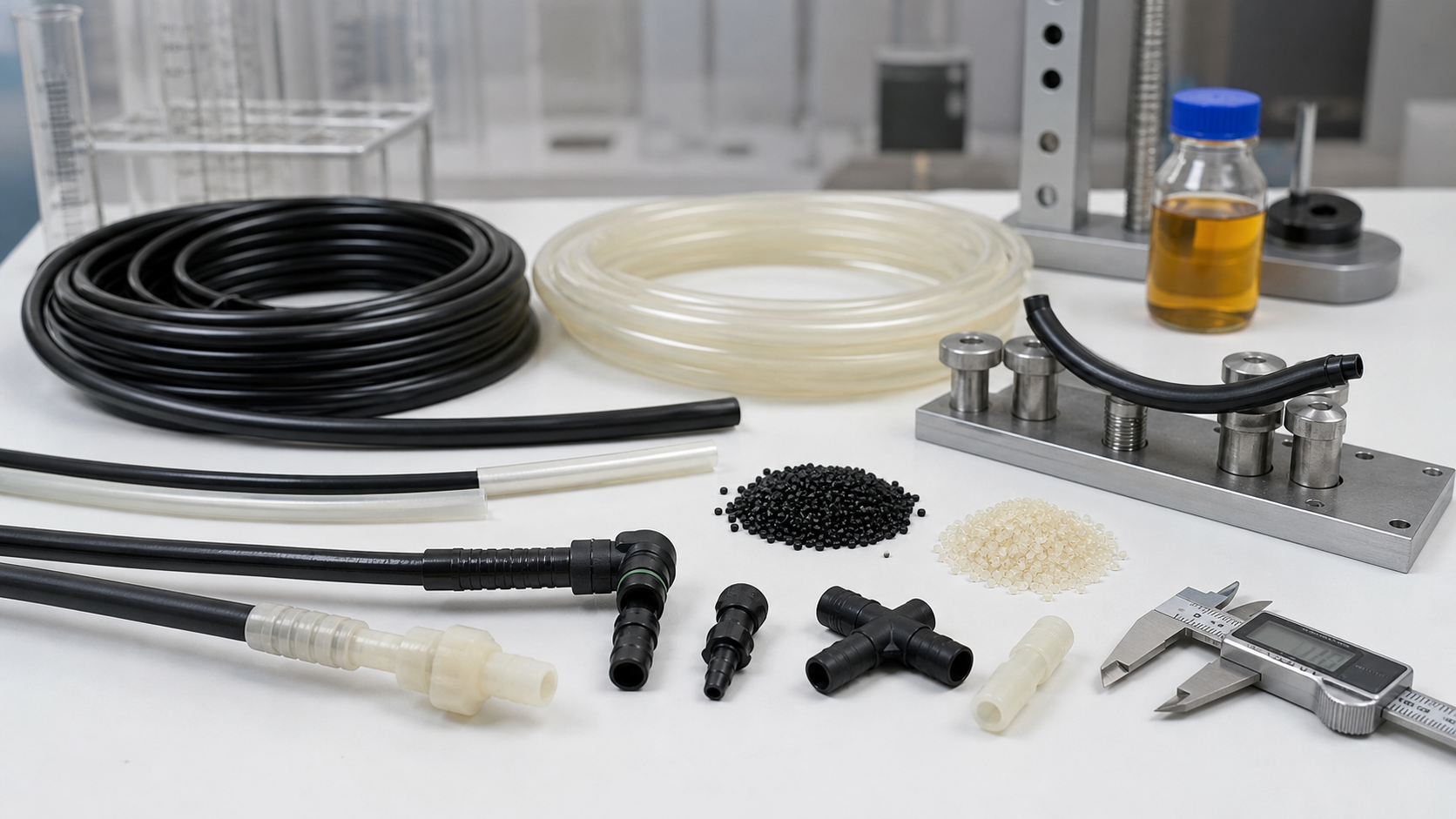
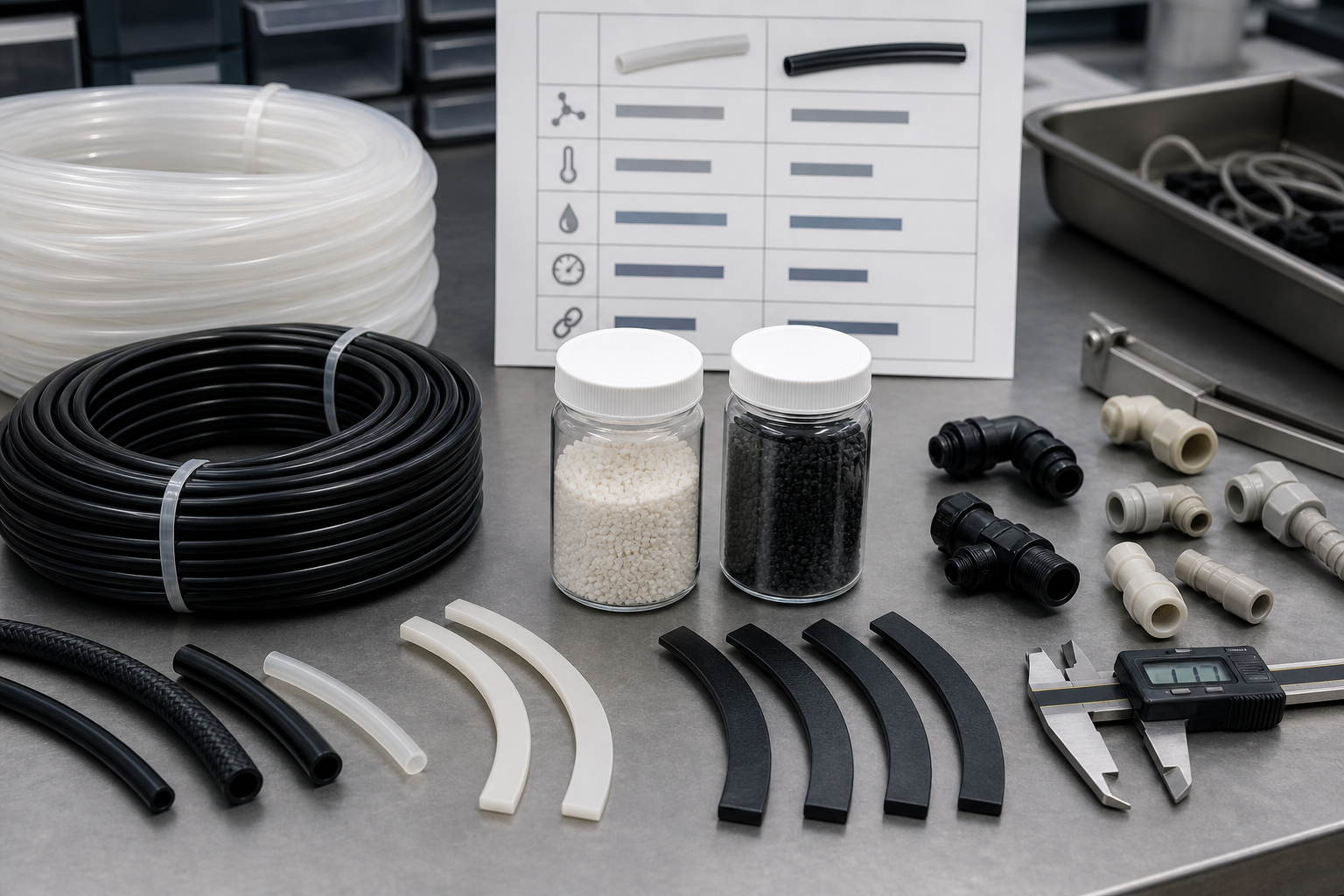
PA11 and PA12 both offer lower moisture uptake than PA6 and PA66, which helps with dimensional stability and retention of mechanical performance. They are widely used in tubing, connectors, cable hardware, and flexible components that operate in harsher service environments.
Both grades are also strong candidates when buyers want better chemical compatibility than a conventional short-chain nylon can provide.
Where PA11 Tends to Win
PA11 is often favored when bio-based sourcing, cold impact, and durable flexibility are part of the value proposition. It also fits projects where sustainability messaging matters alongside functional performance.
For some flexible and outdoor systems, PA11 can provide the right balance of resilience and environmental story.
Where PA12 Tends to Win
PA12 is frequently preferred in fuel and fluid-handling systems because of its very low moisture uptake, strong dimensional stability, and long field history in automotive tubing and connector assemblies.
If the application is highly sensitive to swell, dimensional drift, or low-temperature handling performance, PA12 often enters the shortlist quickly.
| Beslissingsfactor | PA11 | PA12 |
|---|---|---|
| Moisture absorption | Laag | Zeer laag |
| Bio-based content | Strong advantage | Usually petrochemical |
| Fuel-system history | Goed | Very strong |
| Flexible tubing use | Strong | Strong |
| Dimension stability in humidity | Goed | Often better |
How Procurement Teams Should Compare Them
Do not compare only resin price per kilogram. Compare the total cost of qualification, field reliability, moisture conditioning, and scrap risk if the wrong grade shifts dimensions after assembly.
Supplier capability, global availability, and formulation support also matter because many projects need stabilized, conductive, or filled variants rather than a generic base resin.
Buyer Questions Before Requesting a Substitute
- Is the existing material identified by an exact grade and approval, or only by PA11/PA12?
- Which fuel, salt, cleaner, humidity, temperature, pressure, and exposure duration apply?
- Are dimensions checked dry, conditioned, or after fluid exposure?
- Must the supplier document bio-based content, recycled content, food contact, automotive, or other compliance?
- Will the part be extruded, molded, machined, or printed, and is the quoted grade qualified for that route?
For tubing and fluid systems, material approval should follow the complete assembly rather than a resin plaque alone. Bend radius, connector retention, permeation, pressure cycling, thermal cycling, fluid aging, and dimensional recovery can expose differences that a short tensile comparison misses. Define the test medium, temperature, duration, sample conditioning, and pass/fail criteria before comparing supplier samples.
Hoe nylonplastic de evaluatie ondersteunt
Nylon Plastic has worked across material modification and finished plastic-part manufacturing since 2005. This allows buyers to connect the resin decision with extrusion, injection molding, CNC machining, or additive-manufacturing constraints rather than approving a grade from a family name or one dry data-sheet value.
- Compare unfilled PA, PA-GF20, and PA-CF30 against the actual failure mode.
- Review custom compounding when a standard grade misses stiffness, impact, color, wear, heat, or compliance requirements.
- Define TDS, COA, moisture, sample approval, traceability, and lot-release requirements before volume ordering.
Gerelateerde lezen
Veelgestelde vragen
Wat is het belangrijkste verschil tussen PA11 en PA12?
PA11 is often selected for flexibility, low-temperature toughness, and a bio-based feedstock route, while PA12 is often selected for lower moisture uptake and dimensional stability. Exact grades still require application testing.
Which is better for fuel lines, PA11 or PA12?
Both families contain grades used in fluid systems. The correct choice depends on fuel blend, additives, pressure, temperature, wall thickness, permeation target, fittings, and the required qualification standard.
Can PA11 and PA12 be substituted using only a data sheet?
No. Compare conditioning, test method, processing route, dimensional state, chemical exposure, and approval status, then validate the actual component.
What should a PA11 or PA12 RFQ include?
Include the incumbent grade, drawing, process, annual volume, service fluids, pressure, temperature, humidity, critical dimensions, color, and required certifications.
Request a PA11 or PA12 Grade Review
Send the drawing, current grade, process route, annual volume, and service environment for a material and documentation review.