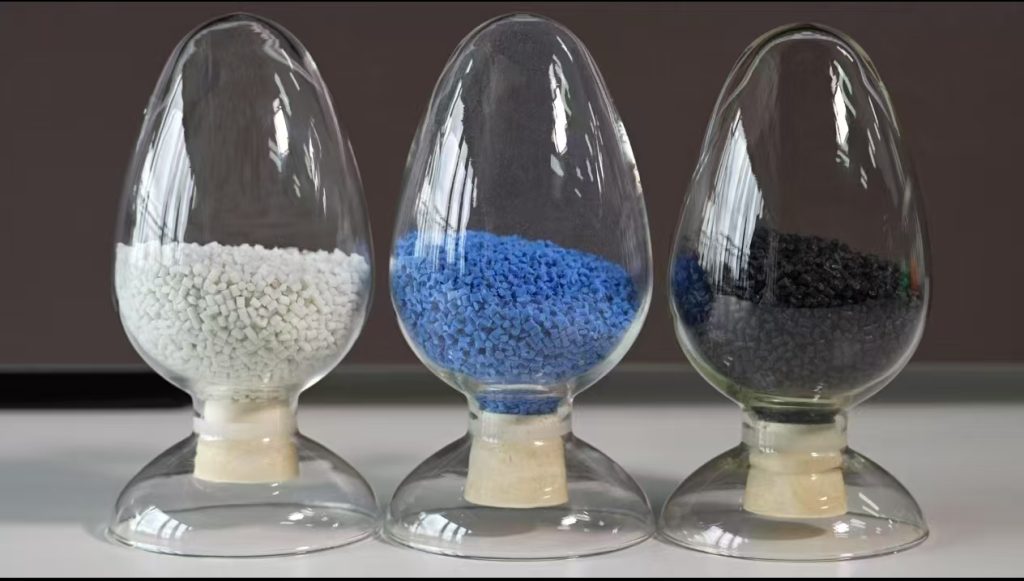
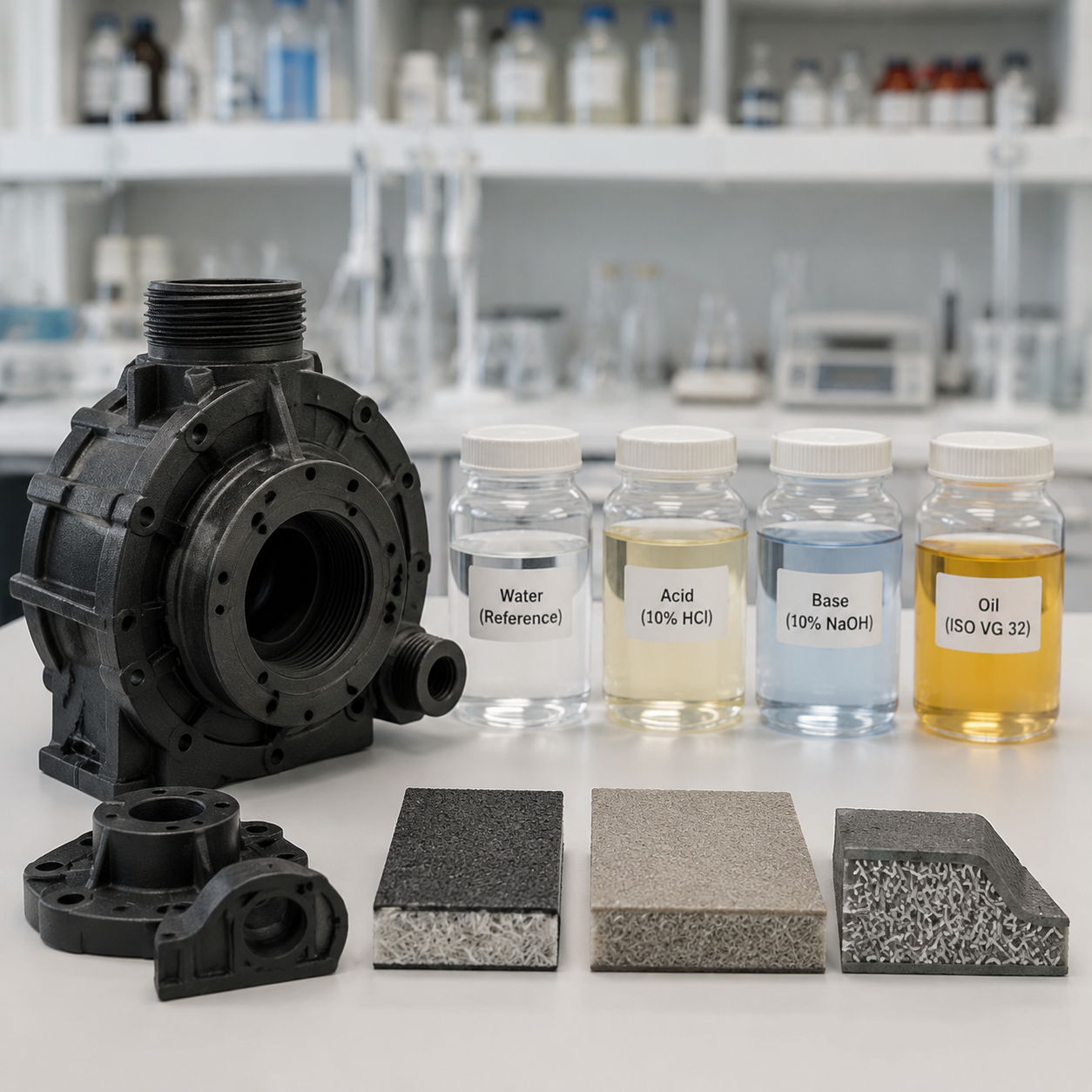
Glass-filled nylon chemical resistance is often misunderstood because reinforcement improves stiffness and creep, but it does not automatically solve the base nylon chemistry. A glass-filled grade can still fail if the resin matrix does not like the fluid, heat, or moisture cycle.
For the base-material view, start with our nylon chemical resistance guide. For grade selection, also review glass-filled nylon en PA66 GF15 versus GF30 versus GF60.
Bottom line: GF nylon is usually a structural upgrade first, not a chemical upgrade. If the fluid is the main risk, solve chemistry first and reinforcement second.
In één oogopslag
| Vraag | Short Answer | Waarom het belangrijk is |
|---|---|---|
| Does glass fiber improve chemical resistance? | Not automatically | The nylon matrix still controls most compatibility. |
| Does it improve dimensional stability? | Usually yes | Less creep and lower movement can help fit. |
| Does it reduce moisture sensitivity? | Only partly | Water still affects the nylon phase. |
| Can fillers create new risks? | Ja | Surface exposure, crack paths, and weld lines still matter. |
| Is GF nylon better for hot fluid service? | Sometimes structurally | But chemistry still needs separate review. |
What Glass Fiber Actually Changes
Glass fiber usually helps stiffness, creep resistance, and heat deflection. That can make a part survive longer under load. But if the chemical attack is happening in the polyamide itself, the fiber does not cancel that mechanism.
Where Designers Get Misled
A GF30 or GF50 grade can look stronger in the datasheet, so teams assume it is also safer in chemical service. Sometimes the part becomes more dimensionally stable while still losing toughness, especially around weld lines, notches, or stressed corners.
What Changes in Real Parts, Not Just in Datasheets
In actual molded parts, reinforcement changes how stress moves through corners, knit lines, and screw bosses. That can help the part stay stiffer, but it can also make a chemically stressed area less forgiving once cracking begins. The resin is still doing the chemical work. The glass is mainly changing the mechanical response around it.
This is why glass-filled nylon should be reviewed at the part level, not only by resin family. Geometry, gate position, fiber orientation, and local stress all affect whether the grade becomes more robust or simply more brittle under exposure.
Practical Rule
Use glass-filled nylon to improve structural performance, not as a shortcut for chemical compatibility. First choose a nylon family that fits the fluid. Then decide whether glass reinforcement helps the mechanical side enough to justify it.
Validation Checklist for GF Nylon
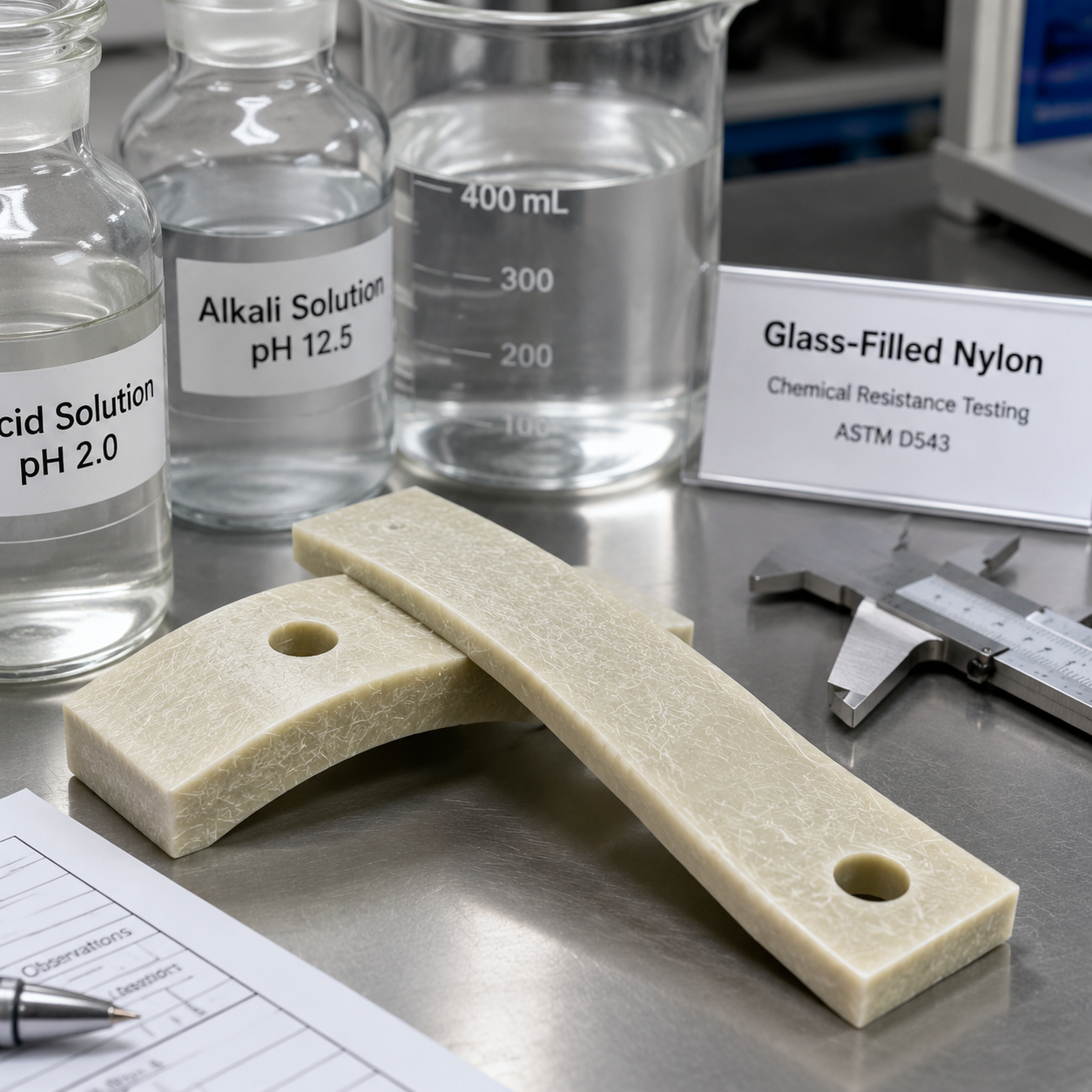
- Check the base nylon family first: PA6, PA66, PA12, or another grade.
- Review where weld lines, sharp corners, and fastener loads sit in the part.
- Do not assume a higher glass percentage automatically means better fluid durability.
- Test after molding, conditioning, and chemical exposure, not only from supplier data.
- Watch for toughness loss as closely as dimensional movement.
Typical Application Example
A stiff mounting bracket or housing can benefit from GF nylon when creep control matters. But if that same part sits in hot cleaner or coolant, the grade still has to survive the fluid first; otherwise the added stiffness only makes a bad choice fail in a more brittle way.
Gerelateerde lezen
- Nylon chemical compatibility chart
- Glasvezelversterkte nylon geleider
- Materiaalgids PA12 GF30
- Nylon moisture absorption
FAQ
Vergelijken PA66 properties and PA6 vs PA66 comparison including strength, heat, cost and application recommendations.
Is glass-filled nylon more chemical resistant than unfilled nylon?
Not by default. Reinforcement changes mechanics more than it changes the underlying nylon chemistry.
Does glass fiber reduce water absorption in nylon?
It can reduce overall dimensional movement, but the nylon phase still absorbs moisture and still needs to be evaluated.
Should I choose GF nylon for hot coolant or cleaner exposure?
Only after checking both the fluid compatibility and the mechanical benefit. It is not a shortcut answer.
What is the biggest risk in GF nylon chemical service?
Assuming higher stiffness means higher chemical safety. In many failures, the structural gain hides a chemistry problem until the part cracks in service.
If you are moving from material screening to production, review our nylon engineering plastics page for grade options, nylon injection molding services for molded parts, nylon CNC machining services for machined parts, and nylon 3D printing service for prototypes or low-volume functional parts.
Need help reviewing a GF nylon grade?
Send the fluid, temperature, load, wall section, and target grade. We can help review whether reinforcement really helps.