
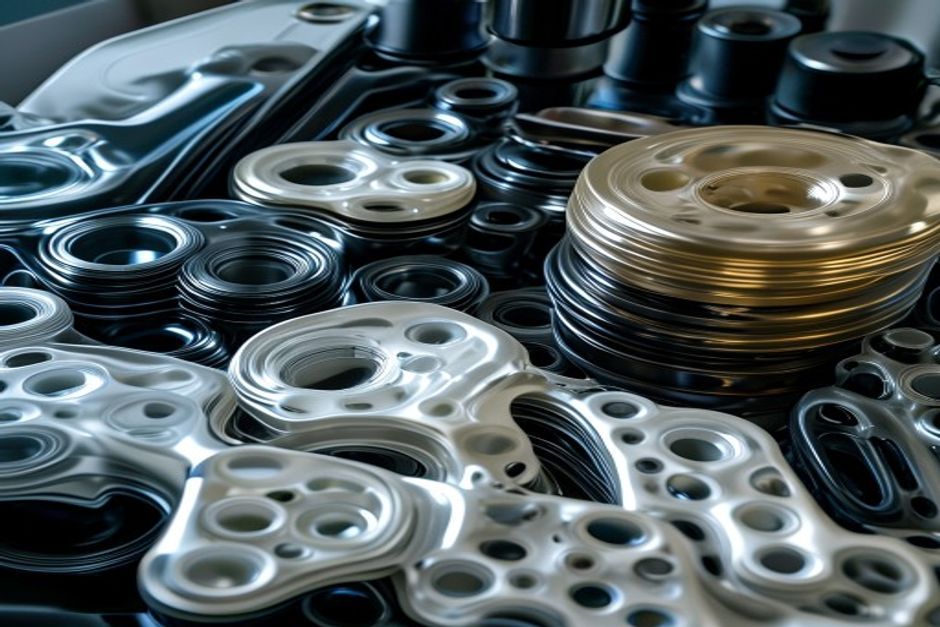
PTFE (Polytetrafluoroethylene) and PEEK (Polyether Ether Ketone) represent the pinnacle of engineering plastic technology. Both are classified as high-performance polymers, capable of operating in extreme environments that would destroy conventional engineering plastics.

PTFE Properties
PTFE offers virtually complete chemical resistance (inert against all common chemicals except molten alkali metals and fluorine), temperature range from -200°C to +260°C, coefficient of friction of 0.05-0.10 (lowest of any solid material), and excellent electrical insulation properties.
PEEK Properties
PEEK provides tensile strength of 90-100 MPa (3-5x stronger than PTFE), temperature resistance up to 250°C continuous, excellent creep resistance at elevated temperatures, and radiation resistance for demanding applications. Carbon fiber reinforced PEEK reaches 200+ MPa tensile strength.
Keuzegids
Choose PTFE for chemical resistance and low friction. Choose PEEK for mechanical strength at temperature. For engineering applications, our PA66-CF30 biedt een uitstekende verhouding tussen sterkte en gewicht.
Source High-Performance Materials
As a specialized source manufacturer, we supply PTFE and PEEK in rod, sheet, and tube forms with full traceability. Neem contact met ons op for pricing.
Vraag een gratis offerte aan
Vul het onderstaande formulier in en onze technici nemen binnen 24 uur contact met u op.
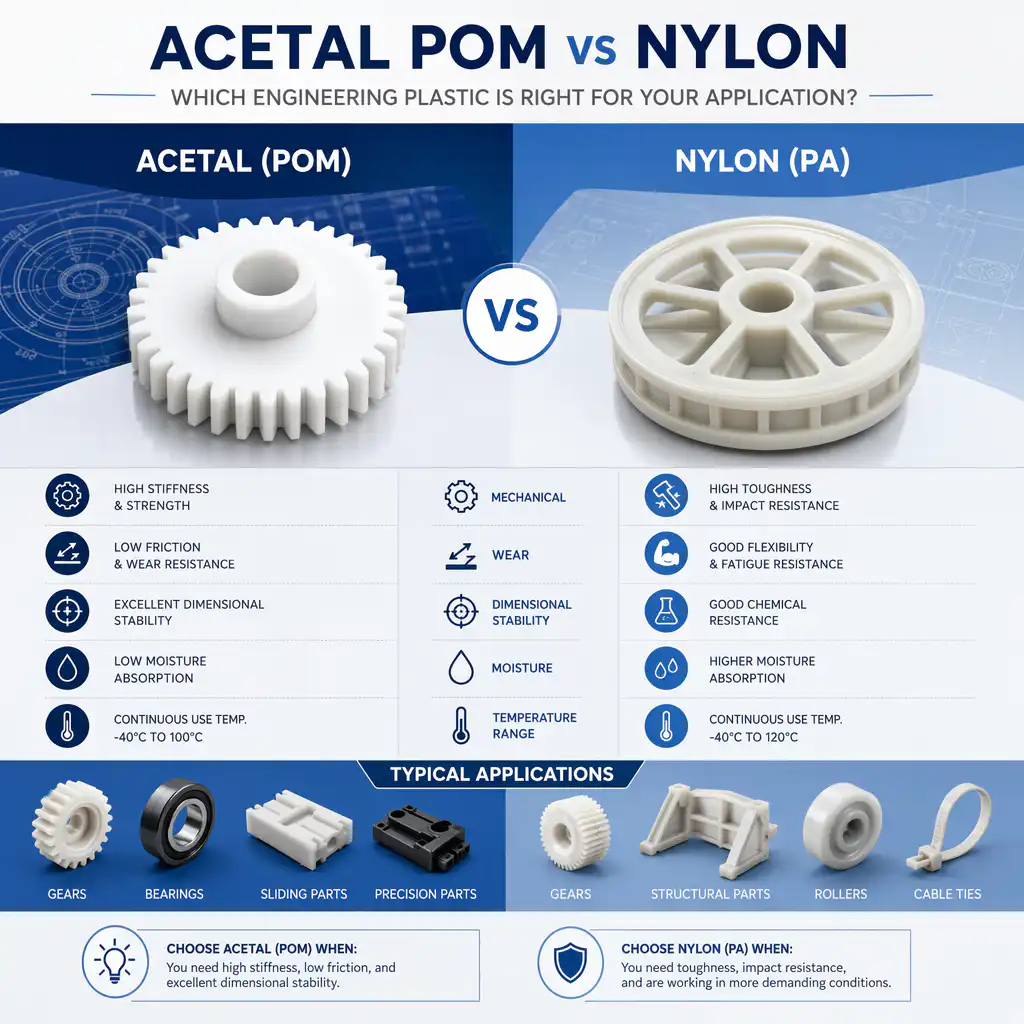
Acetal POM vs Nylon Decision Table
| Vereiste | Acetal POM | Nylon |
|---|---|---|
| Friction and wear | Low friction, good sliding behavior and dimensional stability | Good wear options, often with higher moisture sensitivity |
| Vocht | Very low absorption for stable fits | Absorption can change dimensions and stiffness |
| Strength and heat | Balanced strength with a moderate temperature envelope | Broader reinforced and high-temperature grade choices |
| Process route | Injection molding or CNC with controlled burrs and stress | Dry resin, manage shrinkage and validate fiber orientation where filled |
Choose from the load, friction, moisture, heat and tolerance stack-up of the completed part. Test the actual mating surface, press fit, gear tooth or bushing rather than relying only on a resin datasheet.
FAQ
Wanneer is „Acetal POM versus nylon — Welke technische kunststof is geschikt voor uw toepassing?“ een goede keuze?
Acetaal (POM) versus nylon — Welke technische kunststof is geschikt voor uw toepassing? Dit is een goede keuze wanneer snelle iteraties, complexe geometrie, lage matrijskosten of productie in kleine series belangrijker zijn dan de stukprijs van het spuitgietonderdeel.
Waar moet u op letten bij de keuze tussen acetaal (POM) en nylon — welke technische kunststof is geschikt voor uw toepassing?
Controleer de onderdeelgrootte, materiaaleigenschappen, oppervlakteafwerking, maattolerantie, blootstelling aan hitte, belastingsrichting en of nabewerking nodig is.
Hoe verhoudt Acetal POM zich tot nylon — Welke technische kunststof is geschikt voor uw toepassing? — in vergelijking met CNC-bewerking?
Met 3D-printen kunnen complexe vormen snel worden gemaakt, terwijl CNC-bewerking vaak sterker is voor precieze oppervlakken, nauwere toleranties en productiematerialen.
Wat beïnvloedt de kosten van acetaal (POM) ten opzichte van nylon — Welke technische kunststof is geschikt voor uw toepassing??
De kosten zijn afhankelijk van het materiaal, het bouwvolume, de printtijd, de laaghoogte, het verwijderen van de ondersteuning, de afwerking, de inspectie en het aantal onderdelen in de bouw.

