
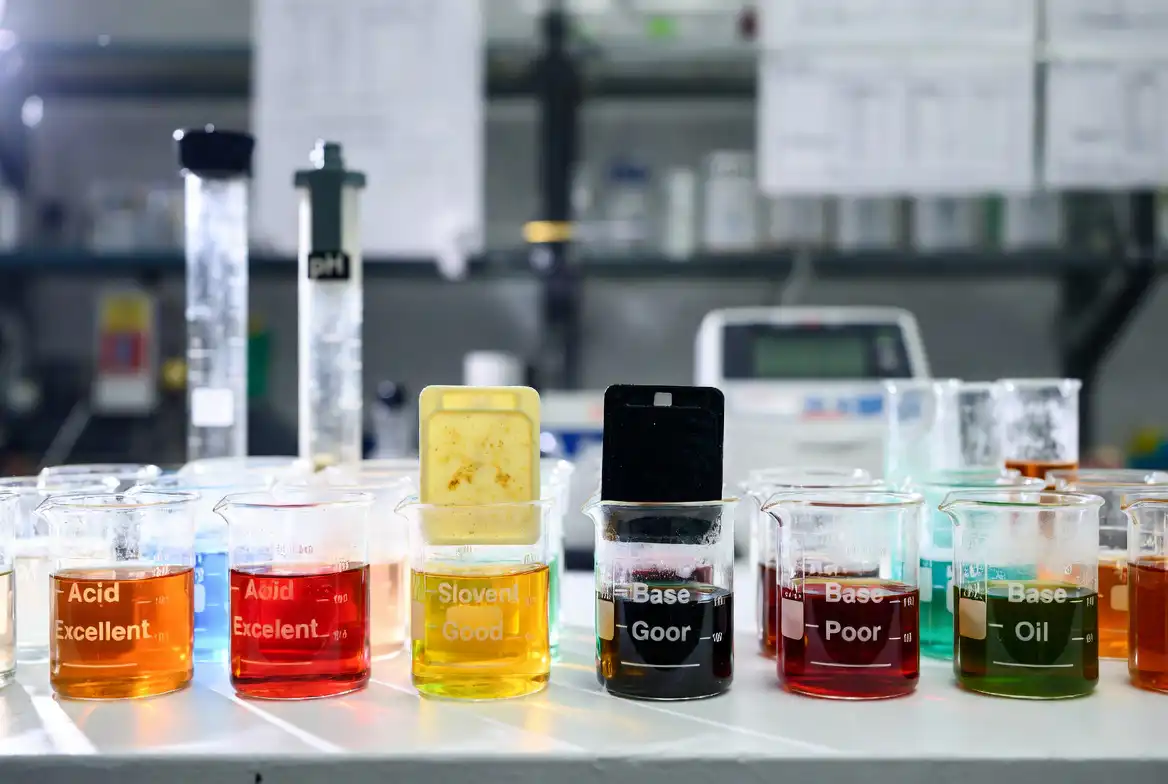
Chemical-resistant plastic selection must match the actual fluid, concentration, temperature, exposure time, stress state, cleaning method and manufacturing route. A compatibility chart is useful for narrowing candidates, but a single “resistant” or “not resistant” label cannot predict every application. Plastics can swell, soften, crack, lose strength, absorb fluid or fail by environmental stress cracking without a large change in weight.
Buyers should ask for grade-specific evidence and define the acceptance condition before ordering parts. The same polymer may perform differently when it is glass-filled, carbon-filled, molded with residual stress, machined from stock, exposed to a sharp notch or held under a constant clamp load.
Define the chemical exposure before choosing a resin
| Exposure variable | What to record | Waarom dit belangrijk is |
|---|---|---|
| Fluid | Exact chemical, mixture, purity and additives | Two fluids in the same family can have very different attack mechanisms |
| Concentration | Nominal and worst-case concentration | Water dilution, solvent content and pH can change swelling or cracking |
| Temperatuur | Normal, peak and thermal cycling | Diffusion and reaction rates generally increase with temperature |
| Neem contact op met | Immersion, splash, vapor, permeation, cleaning or intermittent contact | Duration and surface renewal can change the failure mode |
| Stress | Assembly load, pressure, flex, threads, inserts and residual molding stress | Environmental stress cracking may occur even when bulk immersion looks acceptable |
Compatibility direction by polymer family
| Polymer family | Often considered for | Important cautions |
|---|---|---|
| PEEK | Broad chemical exposure, heat, wear and demanding seals or components | Strong oxidizers, concentrated acids, high temperature and cost still require review |
| PPS | Acids, bases, solvents and hot industrial environments | Reinforcement, brittleness, weld lines and the exact grade affect performance |
| PEI | Electrical and structural parts with heat and moderate chemical exposure | Some ketones, chlorinated solvents and strong bases can cause cracking |
| PVDF | Acids, halogens, salts and chemical handling systems | Temperature, creep, permeation and joining method must be checked |
| PP / HDPE | Many aqueous chemicals, tanks, liners and low-cost fluid-contact parts | Temperature, creep, oxidation and permeation can limit long-term service |
| PA / Nylon | Mechanical parts where strength and wear matter in moderate environments | Moisture, strong acids, hot water and dimensional movement may control the design |
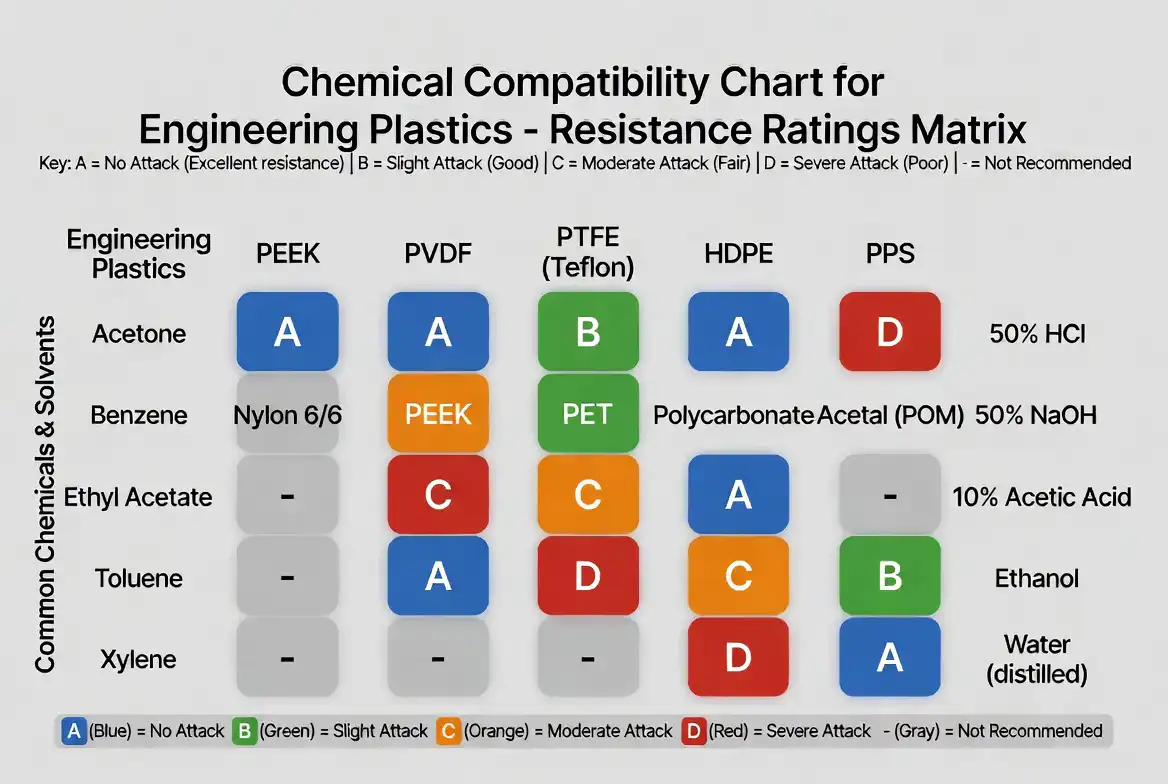
Use this matrix to shortlist materials, then check the exact grade and application. Our nylon chemical resistance guide is narrower than this cross-family selection page, while the high-temperature plastics guide addresses heat and chemical trade-offs together.
Understand the main failure mechanisms
Swelling and softening occur when a fluid diffuses into the polymer and reduces intermolecular forces. The part may gain mass, lose stiffness, change clearance or become easier to deform. Hydrolysis can reduce molecular weight in moisture-sensitive polymers at elevated temperature, especially in hot water or steam. Oxidation or chemical attack can embrittle the surface or reduce strength over time. Environmental stress cracking occurs when a chemical and tensile stress combine to initiate cracks, often at threads, sharp corners, weld lines, press fits or molded-in inserts.
Fillers and additives introduce additional questions. Glass fiber can expose an interface that allows fluid ingress, while carbon fiber, mineral fillers, pigments and flame packages may change the surface or chemical response. A coating, adhesive, lubricant or cleaning residue can be the weakest link even when the base resin is compatible.
Validation for molded, machined and assembled parts
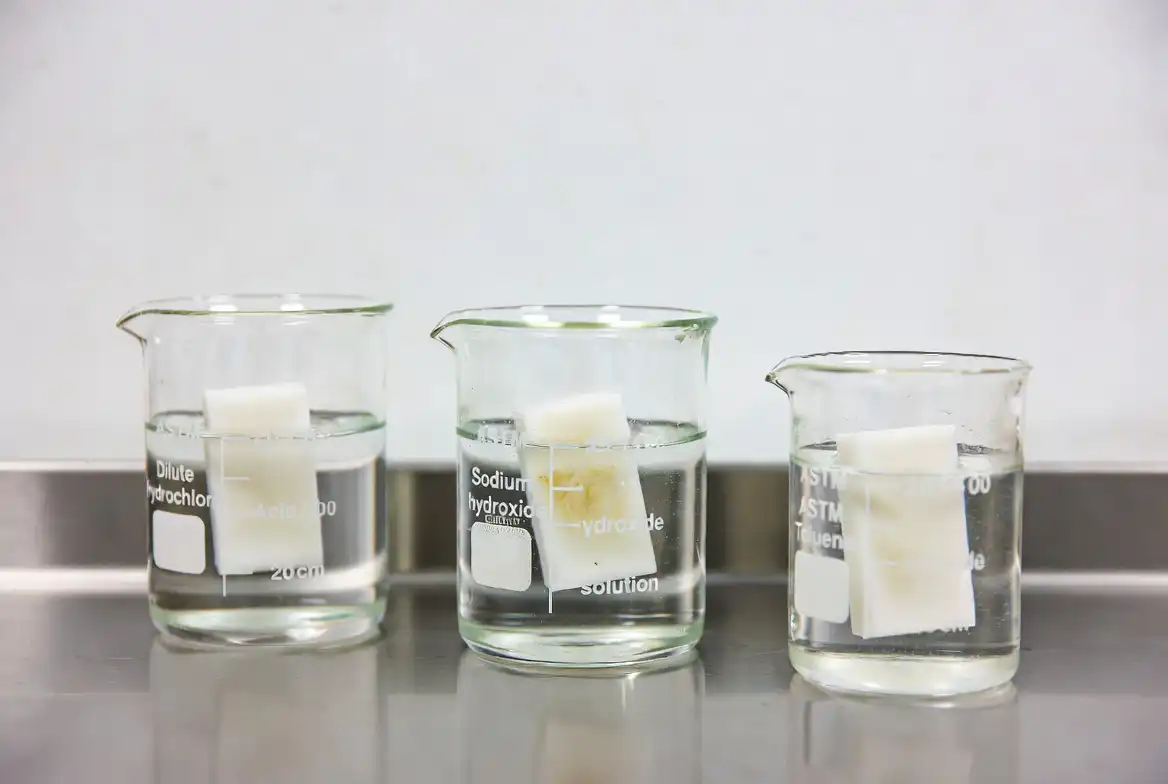
Test representative production material in the final geometry whenever risk is high. Record initial mass, dimensions, hardness or modulus, appearance and critical assembly features. After exposure, repeat the same measurements and inspect for cracks, whitening, blistering, swelling, softening, delamination and loss of seal compression. If a part is under load, test it under the actual or conservatively representative stress rather than using an unloaded coupon only.
- Use the exact resin grade, reinforcement and color planned for production.
- Condition specimens before exposure and control fluid temperature and concentration.
- Include molded weld lines, machined surfaces, threads, inserts and bonded joints.
- Measure both immediate change and change after a recovery or drying period.
- Repeat exposure cycles when the application is intermittent rather than continuous.
- Define failure as a functional, dimensional, visual or mechanical limit.
Design and supplier RFQ checklist
Provide the CAD model, drawing, polymer target, fluid list, concentration, temperature, pressure, exposure cycle, stress condition, quantity and process route. Identify sealing surfaces, threads, snap-fits, transparent windows, inserts and cosmetic zones. State the required life, allowable swelling, clearance, torque, leak rate, mass change or retained strength.
Ask the supplier to identify the proposed grade, compatibility evidence, drying or conditioning requirement, manufacturing risks and validation sample plan. For a new chemical or temperature combination, request a pilot lot and agree who will perform the exposure test and approve the final acceptance report.
How to plan a useful chemical exposure test
A good test reproduces the variables that drive failure. Use production material, production thickness and representative surfaces. Include molded corners, weld lines, threads, press fits and bonded joints when they will be present in the final part. Expose one group without load to measure bulk compatibility and another group under representative strain or pressure to identify environmental stress cracking. Keep an unexposed control group from the same material lot.
Measure before exposure, during the planned interval and after the part has been allowed to recover or dry when recovery is possible. Useful measurements include mass, thickness, critical clearances, hardness, tensile or flexural retention, seal compression, leak rate and visual cracking. Photograph the same locations and record whether the failure began at a surface, weld line, insert, machined edge or adhesive. A pass/fail decision should be tied to product function, not only to a percentage change in mass.
For intermittent cleaning or splash applications, a repeated cycle can be more informative than one long immersion. Include temperature changes, drying, pressure pulses, cleaning concentration and the time between exposures. If the chemical is proprietary or varies by site, define an approved equivalent and a change-control rule so a new cleaner does not silently invalidate the material selection.
Supplier data is most useful when it identifies grade, specimen condition, test temperature, exposure duration, stress state and the property measured. A chart that only says “good” without those conditions should be treated as a screening reference. If the cost of failure is high, combine supplier data with a pilot part and an application-specific test performed by an agreed laboratory or qualified internal team.
Also review the interfaces around the plastic. A compatible housing can still fail because a gasket swells, an adhesive loses bond, a metal insert creates stress or a cleaner attacks a coating. Include the full contact stack in the qualification plan and document any approved substitutes so procurement changes do not introduce an untested chemical combination.
Where exposure is long term, define an inspection interval and a replacement or maintenance rule. Early visual changes may be acceptable in a hidden component but unacceptable on a seal or transparent cover. Agree these boundaries before testing so the supplier, quality team and end user evaluate the same evidence.
Also record acceptable changes in color, odor, surface gloss and mass when those signals affect cleanliness, leak prevention or release of the finished assembly.
For fluid-handling assemblies, include permeation and pressure retention in addition to visual compatibility. A part can remain intact while allowing a fluid or vapor to migrate through a wall, soften a neighboring seal or contaminate an enclosed space. Wall thickness, temperature gradient and pressure differential should therefore be recorded in the qualification plan.
Do not approve an equivalent resin until its additive package, processing history and intended exposure are reviewed.
Chemical-resistant plastics still require grade-specific validation because concentration, temperature, stress and exposure time can change the result.
Veelgestelde vragen
Which plastic has the best chemical resistance?
PEEK, PPS, PVDF, PTFE and selected fluoropolymers can provide excellent chemical resistance, but the best choice depends on the fluid, concentration, temperature, stress, permeation and process route. No polymer is universally resistant.
Can a compatibility chart replace testing?
A chart is a screening tool, not a complete qualification. Use it to narrow candidates, then confirm the exact grade and test representative parts when temperature, stress, pressure or service life creates meaningful risk.
Why do plastic parts crack in chemicals?
Cracking can result from environmental stress cracking, residual molding stress, press-fit or insert stress, sharp geometry, incompatible cleaners or a fluid that attacks the polymer or an additive package.
Does chemical resistance change with temperature?
Yes. Diffusion and reaction rates usually increase with temperature, and mechanical strength or creep resistance may decrease. Always evaluate the worst-case temperature and exposure duration.
What should a chemical-resistant plastic RFQ include?
Include the exact fluid and concentration, temperature, exposure cycle, pressure, mechanical load, life, grade target, process route, critical dimensions, seal requirements and validation method.

